
Blog Summary
Most AI consulting proposals look the same on paper. Glossy decks, vague deliverables, and pricing that swells once the work begins. Buyers end up overpaying for strategy they cannot operationalize.
This guide breaks down what AI consulting services actually include in 2026. It covers the six service categories vendors should deliver, the three engagement shapes (diagnostic, build, retained), and real pricing ranges from USD 25,000 diagnostics to multi-million-dollar builds. It also flags the contract clauses, scope gaps, and warning signs that quietly cost mid-market buyers six figures.
Most buyers get vague AI proposals. They see glossy decks, generic service lists, and pricing buried under qualifiers. Then six months in, the scope creeps and the invoice grows.
This guide fixes that problem. It breaks down what actual AI consulting services include. It shows real pricing ranges. It explains what happens week by week during an engagement.
We have built and delivered AI systems for telecom and enterprise clients for years. The patterns below come from that work, not from sales brochures.
The market is growing fast. According to BCG AI Radar 2026, companies plan to double AI spending this year. That means roughly 1.7 percent of revenue goes to AI in 2026.
More spending attracts more vendors. Knowing what you should get for your money matters more than ever.
The Full Scope of AI Consulting Services
AI consulting services fall into six categories. Each has a specific deliverable. Each solves a different problem in your AI journey.
Understanding these categories helps you scope engagements correctly. It also helps you spot gaps in a vendor proposal.
1. AI Readiness and Opportunity Assessment
This is where most engagements should start. A consultant evaluates your data, systems, and team capability.
The output is a prioritized use-case backlog. It ranks opportunities by business value and technical feasibility.
You also receive a data audit. It flags quality issues, access gaps, and governance risks.
2. AI Strategy and Roadmap Development
Strategy work answers where AI fits into your business plan. It sequences investments over 12 to 24 months.
Deliverables include a phased roadmap, budget ranges, and team structure recommendations. You also get an executive narrative for board conversations.
Good strategy work ties every initiative to a measurable business outcome. Avoid consultants who stop at capability lists.
3. Data Infrastructure and MLOps Consulting
AI fails without the right data foundation. This service fixes pipelines, storage, and model deployment workflows.
Expect architecture diagrams, tooling recommendations, and a migration plan. The plan should cover both current and future workload needs.
At Telephony Nest, our AI and MLOps work often runs in parallel with model development. Separating them delays launch.
Expert Tip
Never sign an AI build engagement without a data audit completed first. A 4-week diagnostic costs 25,000 to 50,000 dollars. A 6-month build derailed by bad data costs ten times that, plus the lost calendar time. If a vendor will quote a fixed-fee build without seeing your data first, walk away. That quote is built on hope, not on engineering reality.
4. Custom Model Development and Fine-Tuning
Sometimes off-the-shelf models are not enough. Consultants build or fine-tune models for your specific domain.
Deliverables include the trained model, benchmark reports, and a deployment pipeline. You should also receive documentation for ongoing retraining.
Voice AI models, for example, need domain-specific audio. Generic models fail on regional accents and industry terms.
5. AI Product and Workflow Integration
This is where AI meets your actual business systems. Consultants wire models into CRMs, contact centers, or internal tools.
The output is a working production system. It should include monitoring, alerting, and rollback procedures.
Integration is where most projects stall. The model works in a demo. Then it fails on live data.
6. Governance, Compliance, and Risk Advisory
Regulators now treat AI like any other high-risk system. This service builds the policies and documentation you need.
Expect a governance framework, audit trails, bias testing procedures, and incident response plans. These protect you in regulated industries.
How AI Business Consulting Services Are Typically Packaged
Vendors bundle these six categories into three common engagement shapes. Each fits a different stage of AI maturity.
Picking the wrong shape wastes money. A strategy retainer will not build you a working system.
Fixed-Scope Diagnostic (4 to 8 Weeks)
A diagnostic is short, scoped, and cheap relative to a build. It answers whether AI is worth pursuing for a specific problem.
Use it when leadership wants proof before larger commitments. You get a written assessment and a go or no-go recommendation.
Trade-off: you do not walk away with a working system. You walk away with a plan.
Build-and-Transfer (3 to 9 Months)
This is the most common engagement for mid-market buyers. The consultant builds a working AI system and hands it over.
Expect milestone-based payments. Expect a knowledge transfer phase at the end.
Trade-off: you take on operational ownership fast. Plan your internal team capability before signing.
Retained Advisory (Ongoing)
Retained advisory gives you access to senior expertise without a full build. You pay a monthly fee for strategic guidance.
It works well for companies with internal AI teams that need outside perspective. It fails when used as cheap labor for delivery work.
Trade-off: progress depends on your internal execution capacity.
What AI Consulting Services Actually Cost
Pricing varies widely. But the ranges below reflect what mid-market buyers typically see in 2026.
The broader market context helps set expectations. Future Market Insights reports the global AI consulting services market at USD 11.07 billion in 2025. It is projected to grow at 26.2 percent CAGR through 2035.
That growth pressures vendor capacity. Expect firmer quotes and fewer discounts than in 2023 or 2024.
Diagnostic Engagements: USD 25,000 to USD 150,000
Short diagnostics start around 25,000 dollars. Complex enterprise assessments cross six figures.
Price drivers include the number of business units covered and regulatory scope. Document-heavy audits cost more.
Build Projects: USD 75,000 to USD 2,000,000 and Above
A narrow build on existing data infrastructure can land at 75,000 dollars. Enterprise-wide builds with custom models run into the millions.
The biggest cost drivers are data readiness, integration complexity, and model novelty. A greenfield data problem doubles most estimates.
Retained Advisory: USD 10,000 to USD 50,000 per Month
Monthly retainers depend on seniority and hours committed. Expect 10,000 dollars for a fractional AI advisor a few days a month.
Enterprise retainers with named senior partners run 30,000 to 50,000 dollars monthly. Some include bench access for short-term tasks.
Hourly Rates by Seniority
| Role | Typical Hourly Rate (USD) | Typical Use |
| Junior AI/ML engineer | 75 to 150 | Implementation, testing |
| Senior AI/ML engineer | 175 to 300 | Model design, review |
| Solutions architect | 225 to 400 | System design, integration |
| Principal or partner | 400 to 800 | Strategy, executive advisory |
Rates vary by geography and firm tier. Boutique firms in high-cost markets push the upper bounds.
Pricing Models Compared
Three pricing models dominate AI consulting. Each shifts risk differently between you and the vendor.
Time and Materials
You pay for hours worked plus expenses. The vendor carries little risk.
This model works when scope is genuinely unclear. It fails when it lets vendors drag out discovery indefinitely.
Protect yourself with weekly burn reports and hard caps. Never sign open-ended T&M for more than eight weeks.
Fixed Fee
The vendor quotes a single price for a defined scope. You carry the risk of any scope you forgot.
Fixed fee works best after a diagnostic has clarified requirements. It forces discipline on both sides.
Watch the change-order clause. That is where hidden upside lives for the vendor.
Outcome-Based Pricing
Fees depend on hitting a business metric. Think revenue lift or cost savings.
Pure outcome-based pricing is rare in AI consulting. Measurement disputes kill most deals within a year.
When offered, read the measurement clause twice. Make sure the baseline is locked and instrumented before work starts.
What’s Included vs What Becomes an Upsell
This section saves you the most money. Most scope disputes come from assumptions that never got written down.
Typically Included
- Discovery interviews with stakeholders you name in the contract
- One primary deliverable document such as an assessment or roadmap
- Two rounds of revisions on written deliverables
- Kickoff and closeout workshops
- Weekly status reports during active work
- Access to the named consulting team through agreed channels
Commonly Billed Separately
- Third-party software licenses including model API costs
- Cloud compute and storage during development and testing
- Additional stakeholder workshops beyond the agreed count
- Extended training for your internal team
- Post-launch support beyond the initial warranty period
- Integration with systems not listed in the original scope
- Data labeling and annotation work
Questions to Ask Before Signing
Before any contract is signed, get answers to these questions in writing:
- Who are the named consultants and what percent of their time is committed?
- What cloud costs will we pay directly versus through the vendor?
- How many revision rounds are included per deliverable?
- What triggers a change order, and how is it priced?
- What happens if we pause the project for internal reasons?
What the Engagement Actually Looks Like Week by Week
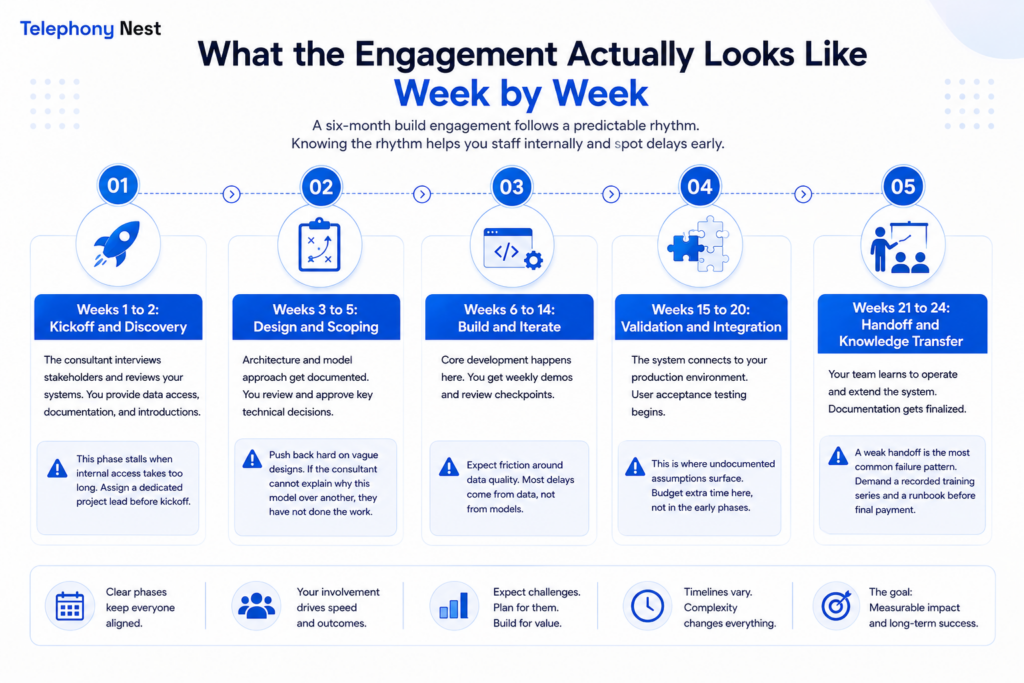
A six-month build engagement follows a predictable rhythm. Knowing the rhythm helps you staff internally and spot delays early.
Weeks 1 to 2: Kickoff and Discovery
The consultant interviews stakeholders and reviews your systems. You provide data access, documentation, and introductions.
This phase stalls when internal access takes too long. Assign a dedicated project lead before kickoff.
Weeks 3 to 5: Design and Scoping
Architecture and model approach get documented. You review and approve key technical decisions.
Push back hard on vague designs. If the consultant cannot explain why this model over another, they have not done the work.
Weeks 6 to 14: Build and Iterate
Core development happens here. You get weekly demos and review checkpoints.
Expect friction around data quality. Most delays come from data, not from models.
Weeks 15 to 20: Validation and Integration
The system connects to your production environment. User acceptance testing begins.
This is where undocumented assumptions surface. Budget extra time here, not in the early phases.
Weeks 21 to 24: Handoff and Knowledge Transfer
Your team learns to operate and extend the system. Documentation gets finalized.
A weak handoff is the most common failure pattern. Demand a recorded training series and a runbook before final payment.
Contract Terms That Matter Most
Most buyers focus on price and timeline. The clauses below matter more over a three-year horizon.
Intellectual Property Ownership
You need to own the custom code, the trained model weights, and the training configurations. Get this in writing.
Vendors sometimes retain rights to reusable frameworks. That is reasonable. But your business logic and model weights should be yours.
Data Rights and Retention
Define who can use your data for what. Prohibit training on your data unless you have explicitly approved it.
Specify data retention and deletion timelines. Require written confirmation when the engagement ends.
Termination and Exit Clauses
You should be able to exit for convenience with 30 to 60 days notice. Lock in the transition support that will happen if you do.
Avoid clauses that penalize you for moving to a different vendor. These are common and negotiable.
Model Portability
Models should be deliverable in standard formats. Avoid proprietary wrappers that lock you to one cloud or one vendor tool.
Portability matters more than most buyers realize. Cloud pricing and model options change fast.
Service Level Agreements
Deliverables need acceptance criteria and timelines. Without them, missed milestones have no consequence.
For production systems, specify uptime, latency, and incident response terms. Tie credits to breaches.
Signs You’re Buying the Wrong Artificial Intelligence Consulting Services
Some warning signs show up during the sales process. Ignoring them costs six-figure mistakes.
- The proposal has no measurable acceptance criteria for deliverables
- Team members are not named, or names change after signing
- Revision rounds are unlimited or unspecified
- The timeline has no dependency on your data readiness
- The strategy deliverable is described as ‘an AI strategy’ with no scope of contents
- Case studies reference technologies, not outcomes
- The firm pushes a build before any diagnostic work
- Pricing is quoted without any clarifying questions about your data
Any one of these is worth a conversation. Two or more is worth walking away.
Choosing an AI Consulting Partner
AI consulting services should feel specific, measurable, and accountable. Vague proposals signal a vague engagement ahead.
Ask for deliverable samples. Ask for named team members. Ask for acceptance criteria in writing.
If you want to talk through a specific use case or review a proposal in hand, we are happy to help. Our AI practice at Ecosmob works with tech leaders on exactly this kind of decision every week.
Frequently Asked Questions
How long does a typical AI consulting engagement take?
Diagnostics run 4 to 8 weeks. Build engagements run 3 to 9 months. Retained advisory is ongoing, with most relationships lasting 12 to 24 months.
Can I hire consultants for just one phase of the work?
Yes. Many buyers hire different vendors for strategy, build, and operations. It requires careful handoff documentation but can lower risk.
What is the difference between AI consulting and AI development services?
Consulting covers strategy, assessment, and advisory work. Development services build and ship the actual system. Most firms offer both, but skill depth varies.
Will consultants use my data to train their own models?
They should not. Your contract must explicitly prohibit this. Ask for written confirmation of data handling practices before sharing anything sensitive.
What happens after the engagement ends?
You should own the working system, the documentation, and the training materials. Most vendors offer optional post-engagement support at a separate rate.
How do I know if I need consulting or full-service delivery?
If you have an internal technical team, consulting alone may be enough. If you do not, you need a partner who can build and operate. We usually help clients assess this during a short diagnostic.