Blog Summary
Most generative AI consulting pitches sound identical. The differences show up in production. This guide covers what GenAI consulting actually involves, how LLM consulting differs from broader AI work, where projects fail most often, what credible partners cost, and when you should not hire one at all.
Every vendor now claims generative AI expertise. Most of them acquired it six months ago. The gap between marketing promises and production-grade GenAI systems is wider than ever. And for companies evaluating
generative AI consulting services, that gap is expensive.
A 2024 Gartner survey found that over 50% of generative AI projects stall before reaching production. The reasons are predictable. Unclear use cases. Underestimated data requirements. Teams that confuse a ChatGPT demo with enterprise readiness.
This guide cuts through the noise. It covers what generative AI consulting actually involves, where LLM consulting differs from broader AI work, and how to evaluate whether a genai consulting partner can deliver results past the proof-of-concept stage.
What Generative AI Consulting Actually Means
Generative AI consulting is not traditional AI consulting with a new label. The technology stack, risk profile, and implementation patterns are fundamentally different.
Traditional AI consulting centers on predictive models. Classification, regression, anomaly detection. Generative AI consulting deals with systems that create. Text, code, images, structured data, synthetic content.
That distinction matters for three reasons:
- Output is non-deterministic. The same prompt can yield different results. This changes how you test, validate, and monitor.
- Data requirements shift. Fine-tuning an LLM is not the same as training a classifier. Context windows, retrieval pipelines, and prompt architecture replace feature engineering.
- Risk surfaces expand. Hallucinations, data leakage, intellectual property exposure, and compliance gaps introduce categories of risk absent from traditional ML.
A credible genai consulting firm addresses all three from day one. If a vendor jumps straight to model selection without a risk and readiness assessment, that tells you something.
Core Services in a Generative AI Consulting Engagement
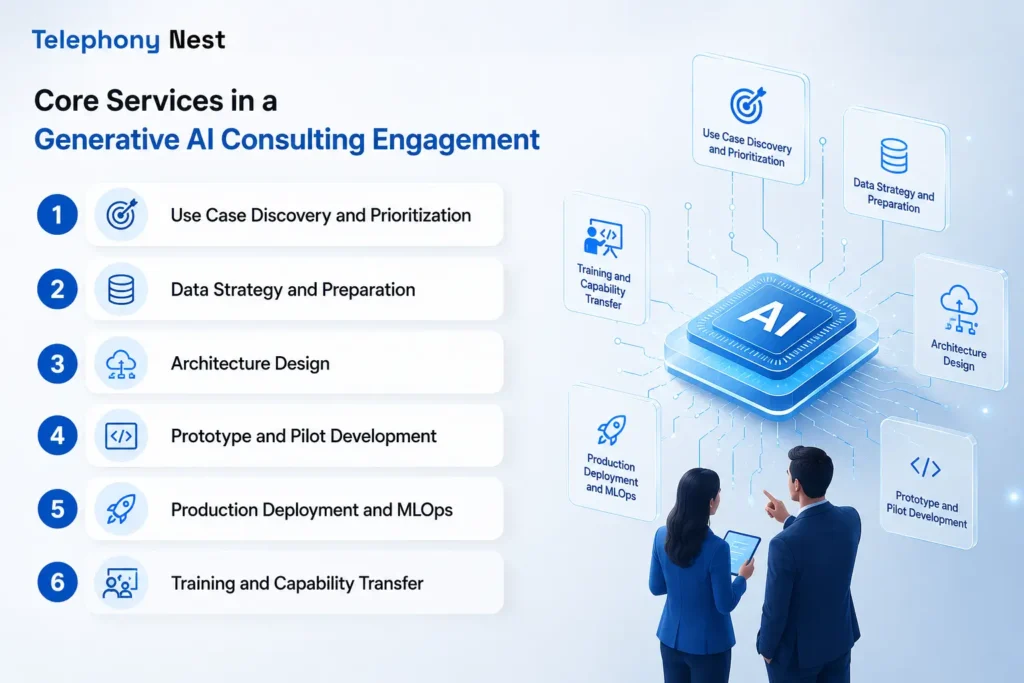
Not every engagement looks the same. But most credible generative AI consulting services cover a common set of capabilities. Here is what a well-structured engagement includes.
1. Use Case Discovery and Prioritization
The first job of any genai consulting partner is to identify which problems generative AI actually solves. Not every workflow benefits from an LLM. A good consultant says no more often than yes.
Prioritization typically maps potential use cases against three axes: business impact, data readiness, and technical feasibility. The highest-value engagements start with one focused use case, not ten parallel experiments.
2. Data Strategy and Preparation
Generative AI is data-hungry. But the data it needs differs from what traditional ML pipelines require.
LLM consulting engagements often focus on unstructured data: documents, emails, support tickets, knowledge bases. The consulting work here includes data audits, quality assessments, chunking strategies for retrieval-augmented generation (RAG), and governance frameworks for sensitive content.
3. Architecture Design
Architecture decisions in GenAI projects carry long-term cost implications. The choices include:
- Foundation model selection (proprietary vs. open-source)
- RAG vs. fine-tuning vs. prompt engineering
- Orchestration layers and agent frameworks
- Guardrails, content filtering, and output validation
- Infrastructure: cloud-hosted APIs vs. self-hosted models
A capable ai consulting company evaluates these tradeoffs against your latency requirements, data sensitivity, and total cost of ownership.
4. Prototype and Pilot Development
Proof-of-concept is where most GenAI projects live and die. A well-run pilot validates three things: technical viability, user acceptance, and measurable business value. Anything less is a demo, not a pilot.
5. Production Deployment and MLOps
Moving from pilot to production is where generative AI consulting earns its fee. Production systems require prompt versioning, model monitoring, cost tracking, latency optimization, and fallback mechanisms.
According to McKinsey’s 2024 State of AI report, only 26% of organizations using generative AI have deployed it at scale beyond initial pilots. The production gap is real.
Stat to Remember
Only 26% of organizations using generative AI have deployed it at scale beyond initial pilots (McKinsey 2024 State of AI). The pilot-to-production gap is where most consulting fees are wasted, and where the best partners actually earn theirs.
6. Training and Capability Transfer
The best generative AI consulting engagements make themselves obsolete. Your internal teams should own the system within 6 to 12 months. That means hands-on training, documentation, and a clear handoff plan.
LLM Consulting: A Specialized Discipline
LLM consulting is a subset of generative AI consulting. It focuses specifically on large language model implementation, optimization, and governance.
If your use case involves text generation, summarization, extraction, classification, or conversational AI, LLM consulting is the relevant specialization.
What LLM Consulting Covers
| Capability | What It Involves | Why It Matters |
| Model Selection | Evaluating GPT-4, Claude, Llama, Mistral, and domain-specific models | Wrong model choice locks you into avoidable cost or capability gaps |
| Prompt Engineering | Designing, testing, and versioning system prompts and chains | Prompt quality drives 60-80% of output quality in production systems |
| RAG Implementation | Building retrieval pipelines over your proprietary data | Connects LLMs to your knowledge without expensive fine-tuning |
| Fine-Tuning | Adapting base models to domain-specific tasks | Necessary when prompting alone cannot meet accuracy requirements |
| Evaluation Frameworks | Automated and human-in-the-loop output scoring | Without measurement, you cannot improve or trust the system |
| Cost Optimization | Token usage analysis, caching, model routing | LLM API costs scale fast without active management |
LLM consulting requires deep familiarity with model behavior, tokenization, context window management, and inference optimization. These skills are distinct from broader data science or software engineering expertise.
Where Generative AI Projects Fail (and How Consulting Prevents It)
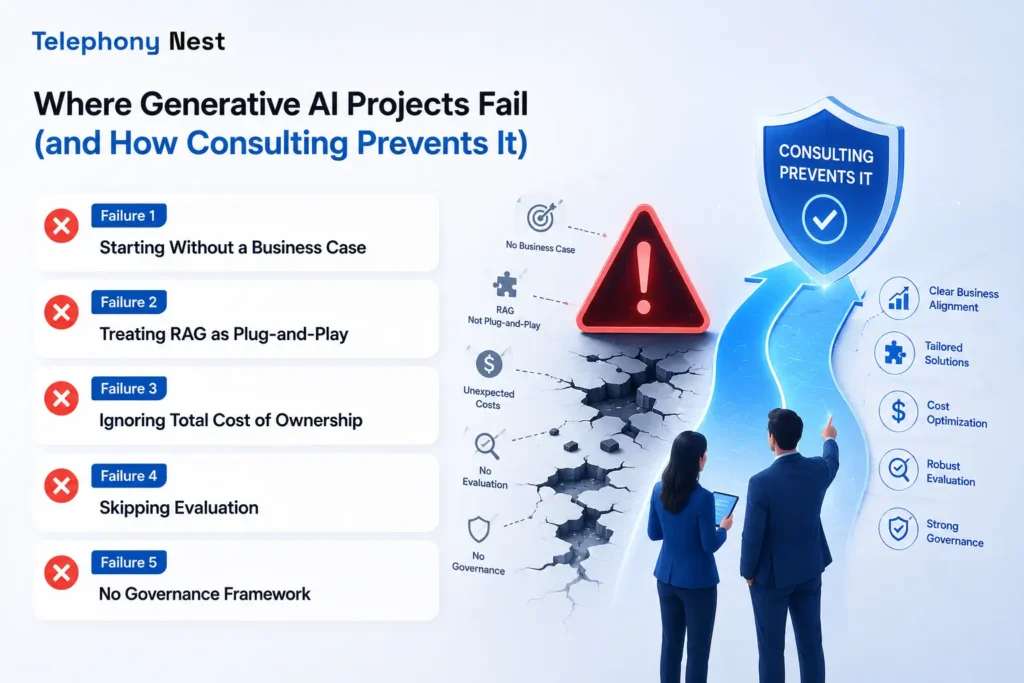
Understanding failure patterns is more useful than studying success stories. Here are the five most common failure modes in GenAI implementations.
Failure 1: Starting Without a Business Case
Teams adopt generative AI because leadership says to. No defined problem. No success metric. No baseline to compare against. A genai consulting partner forces this clarity before any code is written.
Failure 2: Treating RAG as Plug-and-Play
RAG architecture is deceptively simple in demos. In production, it requires careful document chunking, embedding model selection, retrieval ranking, and context window management. Poor RAG implementations hallucinate confidently with your own data, which is worse than hallucinating without it.
Failure 3: Ignoring Total Cost of Ownership
API costs, compute for self-hosted models, vector database infrastructure, human review pipelines, and ongoing prompt maintenance. Organizations routinely underestimate GenAI operating costs by 3 to 5x.
Failure 4: Skipping Evaluation
If you cannot measure output quality, you cannot improve it. Most teams ship GenAI features without automated evaluation pipelines. This creates systems that degrade silently.
Failure 5: No Governance Framework
Generative AI outputs can expose PII, generate biased content, or produce legally questionable material. A robust consulting engagement builds guardrails, audit trails, and human oversight into the architecture from day one.
How to Evaluate a Generative AI Consulting Partner
Vendor Evaluation Checklist
- Names specific models they have deployed in production
- Shares at least one failure case openly
- Has a written evaluation methodology, not just manual review
- Recommends models based on the use case, not vendor incentives
- Includes a documented capability transfer plan
The market is flooded with firms rebranding traditional IT services as generative AI consulting. Use these criteria to separate credible partners from opportunistic ones.
Technical Depth
Ask about specific model architectures they have deployed. Ask about failure cases. Any firm that only discusses successes has not done enough real work.
Production Track Record
Prototypes do not count. Ask how many GenAI systems they have running in production today. Ask about uptime, monitoring, and incident response.
Evaluation Methodology
How do they measure output quality? If the answer is manual review only, they lack the tooling for scalable deployment.
Vendor Independence
A credible ai consulting company recommends the right model for your use case, not the model that earns them a referral fee. Ask about their model evaluation process.
Capability Transfer Plan
The engagement should include a documented plan for your team to take ownership. If the consultant’s business model depends on indefinite dependency, align incentives differently.
Generative AI Consulting Costs: What to Expect
Pricing varies by engagement scope, but the market has established recognizable ranges.
| Engagement Type | Typical Duration | Cost Range |
| Use Case Assessment | 2 to 4 weeks | $15,000 to $50,000 |
| Proof of Concept / Pilot | 6 to 12 weeks | $50,000 to $200,000 |
| Production Build | 3 to 9 months | $150,000 to $750,000+ |
| Ongoing Optimization | Monthly retainer | $10,000 to $50,000/month |
Several factors influence pricing. Model complexity (fine-tuning costs more than prompt engineering). Data volume and quality. Compliance requirements (healthcare, finance, and legal carry higher overhead). Integration complexity with existing systems.
The cheapest engagement is rarely the best value. A $30,000 assessment that prevents a $500,000 failed deployment is the highest-ROI investment in the cycle.
2026 Trends Shaping Generative AI Consulting
The generative AI consulting landscape is evolving fast. These five trends are reshaping how engagements are structured.
Agentic AI Is Moving from Hype to Production
LLM-powered agents that autonomously execute multi-step workflows are the next frontier. Consulting engagements increasingly focus on agent orchestration, tool integration, and safety guardrails for autonomous systems.
Small Language Models Are Gaining Ground
Not every use case needs GPT-4 class capabilities. Smaller, task-specific models offer lower latency, lower cost, and easier compliance. Smart LLM consulting now includes model rightsizing as a core discipline.
Multimodal Capabilities Are Expanding Scope
Text-only consulting is becoming insufficient. Vision, audio, and document understanding capabilities are opening new use cases. Generative AI consulting services now routinely span multiple modalities.
Regulation Is Catching Up
The EU AI Act is in effect. Industry-specific regulations in healthcare and financial services are tightening. Governance and compliance consulting is no longer optional. It is a prerequisite for deployment.
Build vs. Buy Decisions Are Getting Harder
The explosion of GenAI SaaS tools complicates the landscape. A good genai consulting partner helps you evaluate when to build custom solutions and when to adopt existing platforms.
When You Do Not Need Generative AI Consulting
Honest guidance means telling you when not to hire a consultant. Skip the engagement if:
- Your problem is solvable with traditional ML or rule-based automation. Not every problem needs an LLM.
- You have no internal technical team to receive the handoff. Consulting without internal ownership creates permanent dependency.
- Your data infrastructure is not ready. Fix data quality and access first.
- You want a consultant to validate a decision already made. That is not consulting. That is rubber-stamping.
The right time for generative AI consulting is when you have a validated business problem, reasonable data foundations, and internal capacity to own the outcome.
Frequently Asked Questions
What is the difference between AI consulting and generative AI consulting?
AI consulting is a broad category covering predictive analytics, computer vision, NLP, and automation. Generative AI consulting focuses specifically on systems that produce content: text, code, images, and structured data. The technology stack, risk profile, and evaluation methods differ significantly.
How long does a generative AI consulting engagement take?
Assessment phases run 2 to 4 weeks. Pilots take 6 to 12 weeks. Full production builds range from 3 to 9 months depending on complexity. Expect the total cycle from assessment to production to take 5 to 12 months.
Can I use generative AI consulting for internal tools only?
Yes. Many of the highest-ROI GenAI implementations are internal: document processing, knowledge management, code assistance, and workflow automation. Internal deployments also carry lower risk than customer-facing applications.
What should I prepare before hiring a genai consulting firm?
Define the business problem clearly. Inventory your relevant data assets. Identify the internal team that will own the system post-engagement. Set measurable success criteria. Have a realistic budget approved.
Is fine-tuning always necessary?
No. Most use cases are better served by RAG or prompt engineering. Fine-tuning is appropriate when you need consistent output formatting, domain-specific terminology, or performance that prompting alone cannot achieve. A good LLM consulting partner evaluates all options before recommending fine-tuning.