The question has shifted. It is no longer “should we adopt AI?” It is now “how do we make AI work at scale?”
Companies plan to double their AI spending in 2026. BCG’s AI Radar survey of 2,360 executives confirms this. Spending is expected to jump from 0.8% to 1.7% of revenues (BCG, 2026). Nearly three-quarters of CEOs now own AI decisions directly. Half believe their jobs depend on getting AI right.
Yet over 80% of AI projects still fail to reach production. RAND Corporation research confirms this pattern (RAND, 2024). Billions flow in. Results trickle out.
That gap between ambition and execution is exactly where artificial intelligence consulting lives. It exists to help organizations move past experiments into production outcomes.
This guide is for CTOs, VPs, and tech directors. It will help you understand what AI consulting involves. You will learn when you actually need it. And you will know how to evaluate partners objectively. We have built this from hands-on experience. At Ecosmob, we have worked across AI strategy and implementation for years. This guide reflects what we have seen work and fail across real engagements.
Here is everything you need to know.
What Is AI Consulting, Exactly?
AI consulting is expert guidance on adopting AI effectively. An external team helps your organization find where AI creates real value. They build or select the right solutions. Then they make sure those solutions work in production.
That last part matters most. Running a demo is easy. Delivering sustained business outcomes is not.
Here is what AI consulting is not. It is not just building a chatbot. It is not subscribing to an AI SaaS product. It is not hiring a freelance data scientist. Those are components. AI consulting wraps strategy, architecture, implementation, and change management into a unified effort.
It also differs from adjacent services. Data consulting focuses on pipelines and warehouses. Digital transformation consulting covers broader organizational change. ML engineering shops build models but often skip strategy. Artificial intelligence consulting connects all these pieces. It starts with business goals and works backward to technology.
Worth noting: AI consulting in 2026 looks very different from 2020. Back then, it mostly meant building narrow ML models. Today, it spans agentic AI design, LLM integration, governance frameworks, and full organizational enablement. The scope has expanded because AI itself has matured.
What Do AI Consultants Actually Do?
Let us break down the actual services and deliverables. No vague promises. Just tangible work product.
AI Strategy and Roadmapping
This is where most engagements start. Consultants assess your current state. They identify high-impact use cases. They create a phased plan tied to business objectives.
The deliverable is a prioritized AI roadmap. It shows what to build first, what to defer, and why. It accounts for your data maturity, team skills, and budget.
Use Case Identification and Feasibility Analysis
Not every process benefits from AI. Consultants evaluate your workflows. They score potential use cases on feasibility and ROI. They check whether your data can actually support the solution.
This step prevents the most common mistake. It stops teams from building solutions for problems that do not exist.
Solution Design and Architecture
Should you build or buy? Which model fits your needs? How does the solution connect to your existing stack?
Consultants answer these questions. They design system architecture. They select platforms, models, and integration points. At Ecosmob, for instance, our AI solutions team designs architectures that connect with existing telephony and communication systems. The goal is always seamless integration, not a standalone experiment.
Implementation and Engineering
This is hands-on development work. Model training, fine-tuning, pipeline building, and production integration. Some consulting firms handle this entirely. Others partner with your internal engineering team.
The key question: does the engagement produce working software in production? Or just a strategy document? The best firms do both.
AI Governance, Ethics, and Compliance
This has become a standalone service area in 2026. The EU AI Act is now in enforcement phases. Industry regulations are tightening globally. The responsible AI governance consulting market alone is projected to reach $3.14 billion by 2030 (The Business Research Company). That growth tells you how seriously organizations are taking this.
Consultants help set up responsible AI frameworks. They run bias audits on models and training data. They build risk management processes. They create documentation trails that satisfy regulators. They ensure your deployments meet both current and upcoming requirements.
If your AI touches customer data, hiring decisions, credit scoring, or healthcare recommendations, governance is not optional. It is essential. Getting it wrong does not just mean fines. It means reputational damage that no PR budget can fix.
Change Management and AI Enablement
This is the service most competitors ignore. And it is often the reason AI projects fail.
Technology alone does not create outcomes. People do. Consultants train your internal teams on new tools and workflows. They build AI literacy across the organization, not just within engineering. They help create internal centers of excellence that sustain momentum after the engagement ends.
Without change management, you get a working model that nobody uses. Or worse, you get resistance that quietly sabotages adoption. McKinsey research found that organizations reporting significant AI returns were twice as likely to have redesigned end-to-end workflows before selecting models. The human side of AI is not soft. It is structural.
When Does Your Organization Need an AI Consultant?
Here are clear signals that outside expertise would help.
Your team has ambitious AI goals but no ML engineers. You have run AI pilots that never reached production. You are facing regulatory scrutiny on your AI use. You need to evaluate multiple AI vendors but lack the expertise to compare them fairly. Your competitors are deploying AI and your response feels unclear.
Another strong signal: you have valuable data assets sitting unused. You suspect there is opportunity. But you are unsure how to act on it. A consultant can bridge that gap quickly. They bring pattern recognition from similar situations across other organizations.
You might also need a consultant when entering a new AI application area. Maybe your team has NLP experience but needs computer vision. Or you have built predictive models but agentic AI is new territory. Consultants fill these specific skill gaps without permanent headcount.
Finally, consider outside help when speed matters. Building internal AI expertise takes 12 to 18 months. A consulting partner can compress that timeline significantly. If your market window is narrow, speed may justify the investment alone.
When you probably do not need one. If you already have a mature AI/ML team with a clear strategy, a consultant adds less value. If your needs are narrow enough for off-the-shelf AI products, just buy the product. And if your organization is not ready to act on recommendations, do not hire a consultant yet. Their value depends entirely on your ability to execute.
That last point is uncomfortable but honest. Consulting engagements fail when organizations treat them as a checkbox instead of a commitment. If leadership is not prepared to fund implementation after the strategy phase, the strategy is wasted money.
How AI Consulting Engagements Work
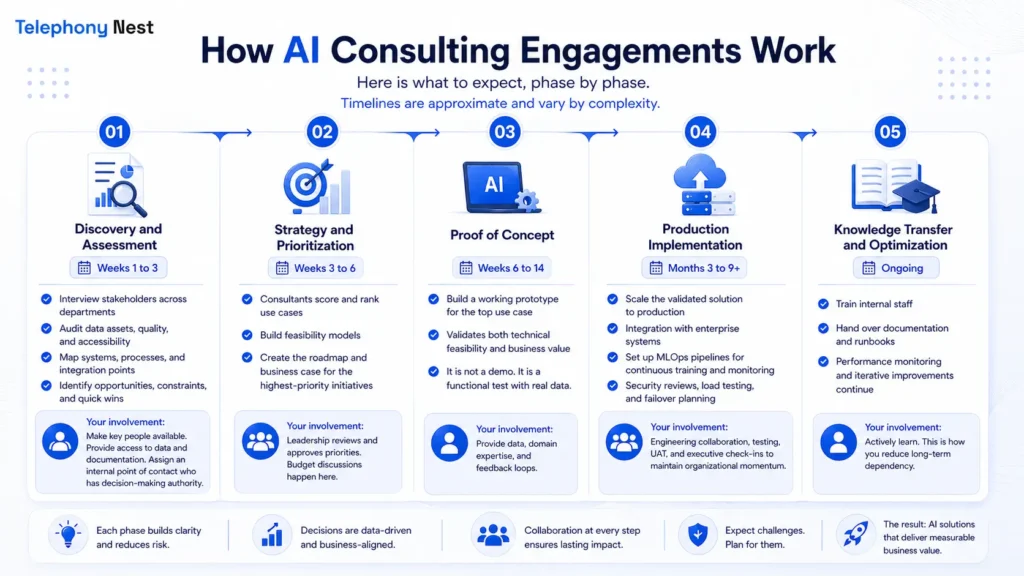
Here is what to expect, phase by phase. Timelines are approximate and vary by complexity.
Discovery and Assessment (Weeks 1 to 3) The consulting team interviews stakeholders across departments. They audit your data assets, quality, and accessibility. They map your current systems, processes, and integration points. They identify opportunities, constraints, and quick wins.
This phase shapes everything that follows. Skipping it or rushing through it is the most common engagement mistake.
Your involvement: make key people available. Provide access to data and documentation. Assign an internal point of contact who has decision-making authority.
Strategy and Prioritization (Weeks 3 to 6) Consultants score and rank use cases. They build feasibility models. They create the roadmap and business case for the highest-priority initiatives.
Your involvement: leadership reviews and approves priorities. Budget discussions happen here.
Proof of Concept (Weeks 6 to 14) The team builds a working prototype for the top use case. This validates both technical feasibility and business value. It is not a demo. It is a functional test with real data.
Your involvement: provide data, domain expertise, and feedback loops.
Production Implementation (Months 3 to 9+) The validated solution scales to production. Integration with enterprise systems happens here. MLOps pipelines are set up for continuous training and monitoring. Security reviews, load testing, and failover planning become priorities.
This is where most AI initiatives die. The jump from a working pilot to reliable production is bigger than most leaders expect. Budget for it generously. Expect surprises.
Your involvement: engineering collaboration, testing, user acceptance, and executive check-ins to maintain organizational momentum.
Knowledge Transfer and Optimization (Ongoing) The consulting team trains your internal staff. They hand over documentation and runbooks. Performance monitoring and iterative improvements continue.
Your involvement: actively learn. This is how you reduce long-term dependency.
How to Choose the Right AI Consulting Partner
Here is a practical evaluation framework.
Assess technical depth. Ask about the team’s backgrounds. Do they have actual AI/ML engineers? Or generalist consultants with AI talking points? Look for engineers who have published research, contributed to open-source, or built production AI systems. Titles alone mean little.
Check industry experience. Have they solved problems in your vertical? Do they understand your data landscape and regulatory environment? A firm that built AI for fintech may struggle with manufacturing constraints.
Evaluate engagement flexibility. Can they scale up or down? Do they offer advisory-only engagements, implementation, or both? Are you locked into long contracts? Flexibility matters because your needs will evolve.
Demand production references. Many firms build impressive demos. Few have systems running in production for months or years. Ask for specific metrics from past deployments. Ask to speak with references.
Assess knowledge transfer commitment. Will your team be smarter after the engagement ends? Or will you need the consultant forever? The best partners build your capability, not dependency.
Check vendor neutrality. Is the firm tied to a specific cloud provider or platform? Biased recommendations cost you money. At Ecosmob, for example, our approach is technology-agnostic. We recommend what fits the problem, not what fits a partnership agreement.
Red Flags to Watch For
Watch out for firms that guarantee specific ROI before understanding your data. Be cautious with consultants who cannot explain their approach simply. Avoid firms with no references from organizations your size. Do not trust anyone pushing proprietary tools that create lock-in. And run from anyone who wants to skip the assessment phase entirely.
A credible consultant asks hard questions before making promises.
AI Consulting Costs: What to Expect in 2026
Pricing in AI consulting is opaque. Let us make it clearer.
Common pricing models include hourly or daily rates, project-based fixed fees, monthly retainers, and outcome-based pricing tied to KPIs. Hybrid models combine two or more of these.
Ballpark ranges for 2026:
A strategy and assessment engagement typically runs $25K to $150K. Proof of concept builds range from $50K to $300K. Full production implementations cost $200K to $2M or more. Ongoing advisory retainers sit between $10K and $50K per month. Individual consultant day rates range from $2,000 to $5,000 depending on seniority.
What drives the variation? Firm size matters. Big 4 firms charge premiums for brand recognition. Boutique firms often deliver equal or better technical talent at lower cost. Complexity of your problem, data readiness, regulatory requirements, geographic location, and engagement duration all affect pricing.
Do not compare consulting costs across firms without checking team composition. A $5,000-per-day rate from a senior ML architect who has deployed 20 production systems delivers different value than the same rate from a junior consultant reading documentation.
The ROI perspective. A consulting engagement is an investment. Compare its cost against the alternative. The average abandoned AI initiative costs $4.2 million in sunk costs, according to S&P Global’s 2025 survey cited in RAND and Deloitte research (Pertama Partners, 2026). Spending $150K on proper strategy upfront can prevent a multi-million-dollar failure.
Also consider the opportunity cost of delay. Every quarter you spend figuring things out internally is a quarter your competitors are shipping AI-powered products and workflows.
AI Consulting Trends Shaping 2026
The landscape is moving fast. Here is what matters right now.
Agentic AI is reshaping engagements. CEOs have committed over 30% of their AI investment to agentic AI this year, per BCG’s survey (BCG, 2026). About 90% of CEOs believe AI agents will produce measurable returns in 2026. Consulting engagements increasingly focus on designing autonomous workflows. These are AI agents that plan, execute, and learn across multi-step tasks. They handle customer service interactions, back-office processes, and operations. This changes what “implementation” looks like. It also raises new questions about safety, control, and oversight that consultants must address.
Governance is now a primary service area. The EU AI Act is in enforcement. Sector-specific regulations are expanding. Organizations hire consultants specifically for compliance. This was a nice-to-have in 2023. It is a business requirement in 2026.
Common Mistakes Tech Leaders Make with AI Consulting
Here is what goes wrong. And how to avoid it.
Starting with technology instead of a business problem. “We need AI” is not a strategy. “We need to reduce customer churn by 20%” is a strategy. Start with the outcome. Let the technology follow. Consultants should push back when goals are vague. If they do not, that itself is a red flag.
Underinvesting in data readiness. Dirty, siloed, or incomplete data kills AI projects. MIT’s 2025 NANDA study found that data readiness and workflow integration failures caused most AI project failures (Fortune, 2025). Expect data preparation to consume a large share of project time. Budget for it. A good consultant will tell you this upfront. A bad one will discover it three months in.
Treating the pilot as the finish line. A working proof of concept is not a production deployment. The gap between the two is where most projects die. Gartner found that on average only 48% of AI projects make it past pilot. Plan and budget for the full journey from day one. If your budget only covers the pilot, you are setting up for an expensive lesson.
Not involving business stakeholders early. AI projects run entirely within engineering tend to solve the wrong problems. Business teams must help define success criteria. They must participate in testing and validation. Without their input, you risk building a technically brilliant solution that nobody wants.
Choosing a consultant based on brand alone. A Big 4 firm name does not guarantee AI expertise. Large firms often staff AI projects with junior generalists who rotate across engagements. Boutique firms and specialized companies may offer senior, dedicated talent at a fraction of the price. Ask who specifically will work on your project. Then verify their experience.
Failing to plan for organizational change. The technology works perfectly. But the team does not adopt it. This is more common than technical failure. Without training, communication, and workflow redesign, the ROI never shows up. Change management is not a luxury. It is a core project requirement.
The LLM hype has matured. The market has moved past “GPT can solve everything.” Consulting now focuses on picking the right model for each task. Fine-tuning economics, inference costs at scale, and model lifecycle management dominate conversations.
Mid-market companies are the fastest-growing segment. AI consulting is no longer Fortune 500 territory. Companies with 200 to 2,000 employees are adopting rapidly. More accessible tools and lower entry costs make this possible. This is a space we focus on at Ecosmob, helping mid-market companies adopt AI without enterprise-sized budgets.
Enablement beats outsourced development. The trend is shifting. Companies want consultants who teach, not just build. “Help us do this ourselves” has replaced “build it for us.” Consulting firms that focus on capability building are winning more engagements. This aligns with how we work at Ecosmob. Our goal is to leave your team stronger, not dependent.
AI consulting is becoming industry-specific. Generic AI advice is losing value. Finance, healthcare, manufacturing, and telecom each have unique data patterns. They face different regulatory landscapes. They require specialized domain knowledge. The most effective consulting partners combine AI expertise with deep vertical experience.
Building Long-Term AI Capability Beyond Consulting
The best consulting engagement makes itself unnecessary.
Structure knowledge transfer from day one. Insist that your team works alongside the consultants, not just watches. Pair each consultant with an internal team member. Make documentation a deliverable, not an afterthought. Code ownership should transfer to your team well before the engagement ends.
Consider building an internal AI center of excellence. Start small. Two or three people who learn deeply during the consulting engagement. Give them dedicated time. Do not split their attention between AI work and legacy projects. Grow the team as your AI maturity increases.
Know when to maintain an ongoing advisory relationship. Some organizations benefit from a monthly retainer for strategic guidance. This costs far less than a full engagement. It gives you access to expertise for complex decisions without long-term dependency. Think of it as having a trusted advisor on call.
Invest in continuous upskilling for your technical staff. AI moves fast. Skills that are current today may be outdated in 18 months. Training programs, certifications, and hands-on project rotations keep your team sharp. BCG’s research shows that leading companies invest twice as much in AI upskilling as their slower-moving peers (BCG, 2026).
Create a feedback loop. After each AI deployment, run a structured retrospective. What worked? What surprised you? What would you do differently? These lessons compound over time. They become your organization’s institutional knowledge about AI.
The goal is not to eliminate the need for outside expertise forever. It is to reach a point where you use consultants for specialized challenges, not basic operations.
Key Takeaways
AI consulting in 2026 is about converting potential into production. The technology is mature enough. The tools are accessible. The challenge is execution, governance, and organizational readiness.
The right consulting partner accelerates your journey significantly. They help you avoid expensive mistakes. They build your team’s capability along the way. They bring pattern recognition from dozens of prior engagements. That experience compresses your learning curve by months or years.
The wrong partner wastes months and budget. They deliver slide decks that collect dust. They create dependency instead of capability.
Use this guide as your evaluation framework. Know when you need help. Know what to look for. Know the red flags. And remember that the goal is always to build your own lasting AI capability.
If you are exploring AI consulting for your organization, we are happy to share how we approach these challenges at Telephony Nest. Our AI solutions team works across strategy, implementation, and enablement. Reach out for a conversation about your specific needs. No pitch. Just clarity on what makes sense for your situation.
Frequently Asked Questions
What is the difference between AI consulting and data consulting?
Data consulting focuses on data infrastructure. Think pipelines, warehouses, and governance. AI consulting builds on that foundation. It adds strategy, model development, deployment, and organizational enablement. You often need both, but they are distinct disciplines.
How long does a typical AI consulting engagement last?
Strategy-only engagements run 4 to 8 weeks. End-to-end engagements that include implementation span 3 to 12 months. Complexity, data readiness, and scope drive the timeline.
Can AI consultants work with our existing tech stack?
Yes, if they are technology-agnostic. Good consultants design solutions that integrate with your current systems. Be wary of firms that push a complete platform replacement as step one.
What should I prepare before engaging an AI consultant?
Identify your top business challenges. Get executive sponsorship. Audit your data assets at a high level. Assign a dedicated internal point of contact. The more prepared you are, the faster the engagement delivers value.
Is AI consulting worth it for mid-sized companies?
Absolutely. Mid-sized companies often see faster ROI because decisions happen faster. The key is finding a partner who understands mid-market constraints. Not every engagement needs a seven-figure budget.
How do I measure the success of an AI consulting engagement?
Define metrics before the engagement starts. Common ones include time-to-production, accuracy of deployed models, operational cost reduction, revenue impact, and internal team capability growth. If your consultant resists measurable goals, reconsider.
What qualifications should I look for in an AI consultant?
Look for a mix of technical depth and business understanding. Advanced degrees in ML or related fields help but are not enough. Production experience matters more than academic credentials. Ask for proof of deployed systems.
Can AI consulting help with regulatory compliance?
Yes. This is one of the fastest-growing service areas. Consultants help with EU AI Act compliance, bias auditing, risk documentation, and sector-specific regulatory frameworks. If you operate in healthcare, finance, or any regulated industry, compliance consulting is essential.