Blog Summary
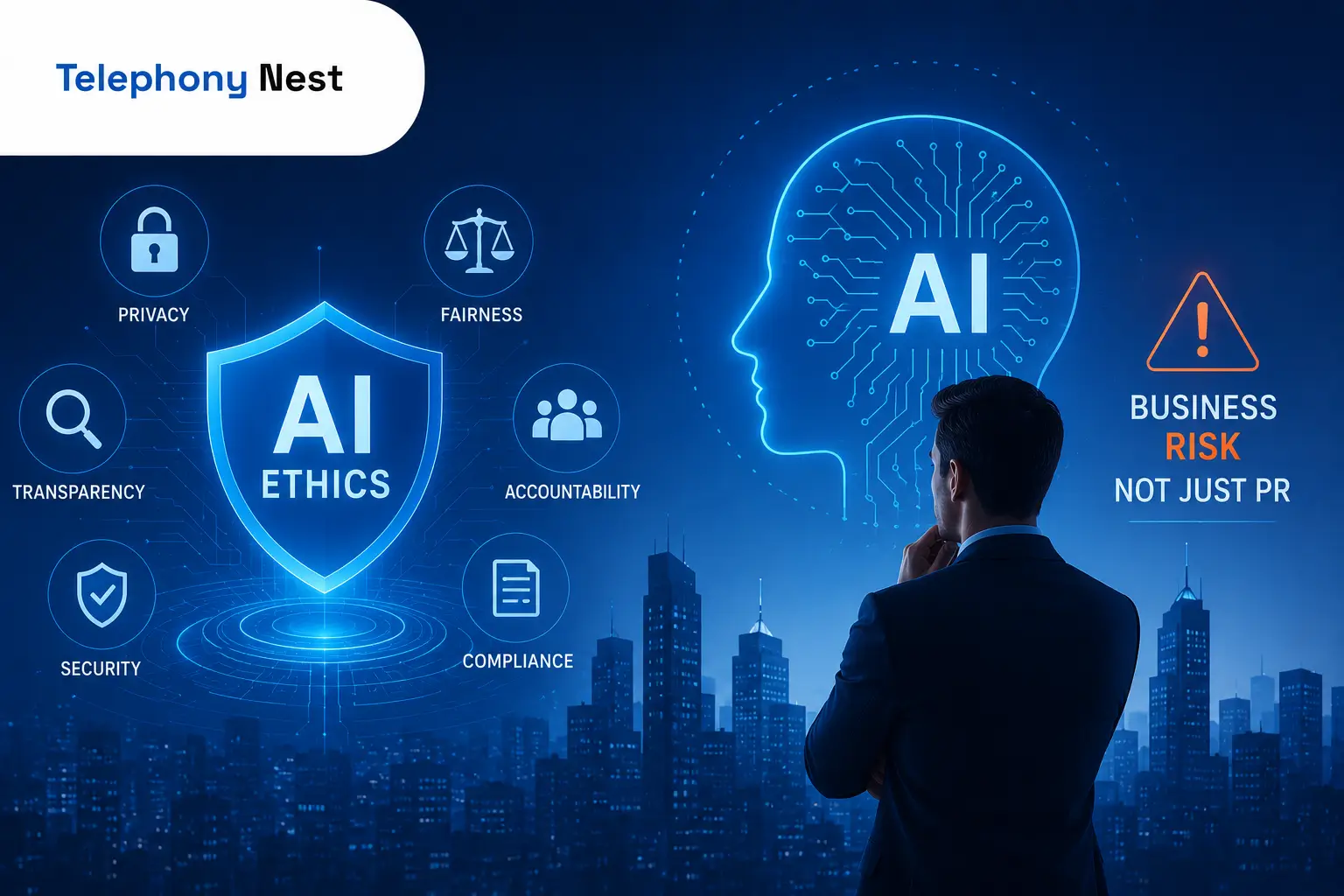
AI ethics consulting used to be a brand exercise. It is now a risk function tied directly to revenue, regulation, and operational continuity. This article covers what the work actually involves, why it has moved from PR to P&L, and how to evaluate a partner who can deliver more than a values statement.
For most of the last decade, AI ethics lived on a slide deck. It was a values statement, a blog post, a pledge signed at a conference. It rarely touched a P&L.
That window has closed.
Regulators are writing fines into law. Insurers are pricing AI risk into premiums. Enterprise buyers now demand model documentation before signing contracts. Employees are walking out over models they consider unsafe. Each of these is a business event, not a values debate.
Responsible AI is no longer a reputation play. It is a risk discipline that decides whether a model ships, whether a deal closes, and whether a regulator opens a file. AI ethics consulting is the function that turns that discipline into something operational.
This guide covers what AI ethics consulting actually involves, why responsible AI consulting now sits inside enterprise risk frameworks, how AI governance and AI risk management connect to delivery, and how to tell a real practice from a checkbox exercise.
What AI Ethics Consulting Actually Means in 2026
The phrase covers more ground than it used to. A working definition: AI ethics consulting helps organizations build, deploy, and operate AI systems in ways that hold up under regulatory, legal, contractual, and operational scrutiny.
That is a longer sentence than usual. It is also the only honest one.
Ethics has expanded into governance, risk, compliance, and assurance. The label has not caught up, but the work has. A credible engagement now touches several disciplines at once.
The work usually includes:
- Model risk assessment across fairness, safety, security, and reliability dimensions.
- Policy design that translates principles into engineering requirements.
- Governance structures that decide who can approve what, and when.
- Documentation systems that satisfy regulators, auditors, and enterprise buyers.
- Incident response plans for when a model behaves badly in production.
- Vendor and third-party AI due diligence.
- Training programs for engineering, product, and legal teams.
None of this lives in a values document. All of it lives in code reviews, deployment gates, contract clauses, and board packs.
Why Responsible AI Is Now a Business Risk
Three forces moved AI ethics from PR into the risk register. They arrived together, and they reinforce each other.
Regulation is no longer theoretical
The EU AI Act is live. Enforcement is staged. Penalties for prohibited practices reach the higher of 35 million euros or 7% of global annual turnover. That is a number that ends careers, not campaigns.
Other jurisdictions are following with different shapes. The US has executive orders, state-level laws like Colorado’s AI Act, and sector-specific guidance from the FTC, SEC, and EEOC. The UK is taking a regulator-led approach. Brazil, Canada, China, South Korea, and Singapore each have frameworks in motion.
A multinational deploying one model now faces overlapping rules. The compliance question is no longer whether to comply. It is which regime governs which use case, and how to evidence it.
Buyers are pricing risk into procurement
Enterprise procurement has changed. AI-specific questionnaires now sit alongside SOC 2 and ISO 27001 requests. Buyers ask for model cards, data lineage, bias testing results, red team summaries, and incident histories.
The market signal is clear. According to BCG’s AI Radar 2026, responsible AI is now treated as a procurement filter at most large enterprises, with buyers requiring documented controls before engagement. Vendors who cannot produce evidence are dropped before pricing discussions begin.
This shifts ethics from a cost center to a sales enabler. Documented controls win deals. Missing controls lose them.
Operational failures are visible and expensive
Models fail in public. A discriminatory loan decision becomes a news cycle. A hallucinated legal citation becomes a court sanction. A leaked prompt becomes a data breach. Each of these triggers regulatory inquiries, litigation, and customer churn.
The base rate of failure is high. MIT’s Project NANDA 2025 study, covered by Fortune, found that 95% of generative AI pilots delivered no measurable P&L impact. A meaningful share of those failures stemmed from issues a responsible AI program is designed to catch early: poor data, unclear ownership, no monitoring, no escalation path.
Responsible AI is not a layer of polish. It is the layer that decides whether the rest of the work survives contact with reality.
AI Governance: The Operating System for Responsible AI
AI governance is the structure that decides who is accountable for which AI decision. It answers questions like:
- Who approves a new model going into production?
- Who owns the model after launch?
- What triggers a model retraining, pause, or rollback?
- Who signs off on changes to prompts, training data, or guardrails?
- Who escalates when a model behaves unexpectedly?
Without governance, ethics becomes a memo. With governance, ethics becomes a workflow.
The three layers of a working governance model
Strategic layer
This is where the board and executive committee sit. They set risk appetite, approve high-impact use cases, and review aggregate exposure. They do not review individual models. They decide which categories of model the company is willing to deploy at all.
Tactical layer
This is the AI risk committee or review board. Cross-functional by design. Includes engineering, product, legal, compliance, security, and a business sponsor. Reviews specific use cases against policy. Approves deployments. Owns the model inventory.
Operational layer
This is where the work happens. Engineering teams follow documented development standards. Product teams complete impact assessments. Legal reviews contracts and data sources. Security runs red team exercises. Each role has a defined input into the governance process.
Most failed AI governance programs collapse the three layers into one. A single committee tries to set strategy, approve deployments, and audit operations. It cannot. The work fragments, deadlines slip, and the program loses credibility.
What good governance documentation looks like
A working governance program produces artifacts that survive an audit. The list is shorter than people expect:
- AI policy that defines prohibited uses, restricted uses, and standard uses.
- Model inventory listing every model in development, production, and retired status.
- Use case risk classification tied to a documented assessment methodology.
- Model cards describing intended use, training data, performance, and limitations.
- Approval logs showing who signed off on what, with what evidence, on what date.
- Incident logs covering near-misses, failures, and post-mortems.
- Vendor assessment records for third-party AI used in the business.
If a consulting partner cannot produce templates for these artifacts on day one, the engagement will spend its first six weeks inventing them. That is six weeks of billing that could have been delivery.
AI Risk Management: From Principle to Practice
AI risk management is the discipline of identifying, measuring, mitigating, and monitoring the risks a model introduces. It borrows heavily from traditional model risk management in financial services, then extends it to handle the specific failure modes of modern AI.
The risk categories that actually matter
A useful taxonomy keeps the list short enough to act on:
Fairness and discrimination
The model produces systematically different outcomes for protected groups. Shows up in hiring, lending, healthcare, insurance, and advertising. Quantifiable through disparate impact testing, equal opportunity metrics, and calibration analysis.
Accuracy and reliability
The model is wrong in ways that matter. Includes hallucination in generative systems, distribution shift in predictive systems, and adversarial brittleness across both. Measured through holdout testing, monitoring drift, and structured red teaming.
Privacy and data protection
The model exposes training data, leaks inference inputs, or enables re-identification. Particularly acute for fine-tuned models on proprietary data. Mitigated through differential privacy, data minimization, and architectural choices.
Security
The model is attacked through prompt injection, data poisoning, model extraction, or adversarial inputs. Treated as a security engineering problem with threat models, controls, and incident response, not a research curiosity.
Operational and third-party
The model depends on external APIs, vendor models, or proprietary data. A vendor outage, license change, or model deprecation becomes a business outage. Managed through contracts, fallbacks, and inventory.
Regulatory and legal
The model triggers obligations under EU AI Act, GDPR, sector regulations, or local laws. Mapped through use case classification and jurisdictional analysis.
Measurement comes before mitigation
Risk you cannot measure cannot be managed. The early phase of a serious AI risk management program is unglamorous. It involves building the data pipelines, evaluation harnesses, and monitoring dashboards that produce numbers.
Data readiness is the most common blocker. Informatica’s 2025 CDO Insights survey found that 43% of technology leaders cited data readiness as their top obstacle to AI adoption. The same pattern repeats in responsible AI: without clean lineage and reliable evaluation data, fairness and accuracy testing is theater.
This is where many ethics consulting engagements lose credibility. They produce a policy without producing the measurement infrastructure that makes the policy enforceable. Policy without measurement is decoration.
Mitigation is layered, not single-shot
No single control eliminates a meaningful AI risk. Working programs layer controls:
- Design controls: model architecture choices, training data filtering, alignment techniques.
- Pre-deployment controls: evaluation, red teaming, impact assessment, sign-off gates.
- Deployment controls: rate limits, output filters, human-in-the-loop, monitoring.
- Post-deployment controls: drift monitoring, incident response, scheduled re-evaluation.
A consultant who only talks about one layer is selling one tool. The category requires all four.
What Separates Real Responsible AI Consulting from a Checkbox Exercise
The market is full of firms offering AI ethics services. The quality range is wide. A few signals separate the practices that move the needle from those selling a deliverable.
They write engineering requirements, not principles
A useful policy reads like a specification. It tells an engineer what to test, what to log, and what to escalate. A principles document tells everyone to be fair and transparent. The first is operational. The second is wallpaper.
This connects to the same operational discipline we wrote about in our earlier piece on what AI consulting actually involves. Responsible AI is not a separate discipline. It is the part of AI consulting where principles get translated into testable code.
They bring templates and reference architectures
A serious practice arrives with model cards, risk assessment forms, governance charters, and policy templates. These are starting points, not finished products. Customization is real work. But starting from zero is a sign the firm has not delivered this before.
They sit inside the delivery process, not next to it
Ethics consulting that runs parallel to engineering produces shelfware. Ethics consulting that sits inside sprints, code reviews, and deployment gates changes what ships.
We covered this integration model in detail when discussing how to choose the right AI consulting company. The same evaluation logic applies here: ask how their work plugs into your existing development workflow, not whether they have a deck on AI ethics.
They measure before they prescribe
Any partner who proposes a complete responsible AI program before assessing your current state is selling a kit. The right sequence is assess, classify, prioritize, then build. The assessment usually reveals that you already have half of what you need, badly organized.
They speak fluently across legal, engineering, and product
Responsible AI is a translation problem. Legal needs precision about jurisdiction and obligation. Engineering needs precision about testable behavior. Product needs precision about user impact. A consultant who can hold all three conversations in the same room is rare and valuable.
How AI Ethics Consulting Fits Different Maturity Levels
Not every company needs the same engagement. The right scope depends on where you are.
Pre-deployment companies
You are building your first production AI system. The priority is establishing minimum viable governance before launch. A focused engagement covers use case risk classification, an impact assessment, basic monitoring, and a one-page incident response plan. Expect six to twelve weeks of work.
Companies with scattered AI in production
Multiple teams have shipped models independently. There is no inventory, no shared standards, and no central oversight. The first job is discovery. Build an inventory, classify what exists, find the highest-risk systems, and put controls around them first. Expect three to six months for a meaningful baseline.
Regulated industries facing audit
Financial services, healthcare, insurance, and increasingly hiring and education. The deliverables are evidence-grade. Model risk management aligned to SR 11-7 or equivalent. Documented controls mapped to the NIST AI Risk Management Framework or ISO/IEC 42001. Engagement lengths run from six months to multi-year programs.
GenAI-heavy organizations
If most of your AI footprint is generative, the risk profile shifts. Hallucination, prompt injection, IP exposure, and content provenance dominate the agenda.
This is where the analysis in our generative AI consulting guide becomes relevant: the risks are different enough that a generic AI governance template will miss the actual failure modes. GenAI-specific controls, evaluation suites, and incident playbooks are now their own discipline.
What an AI Ethics Consulting Engagement Looks Like in Practice
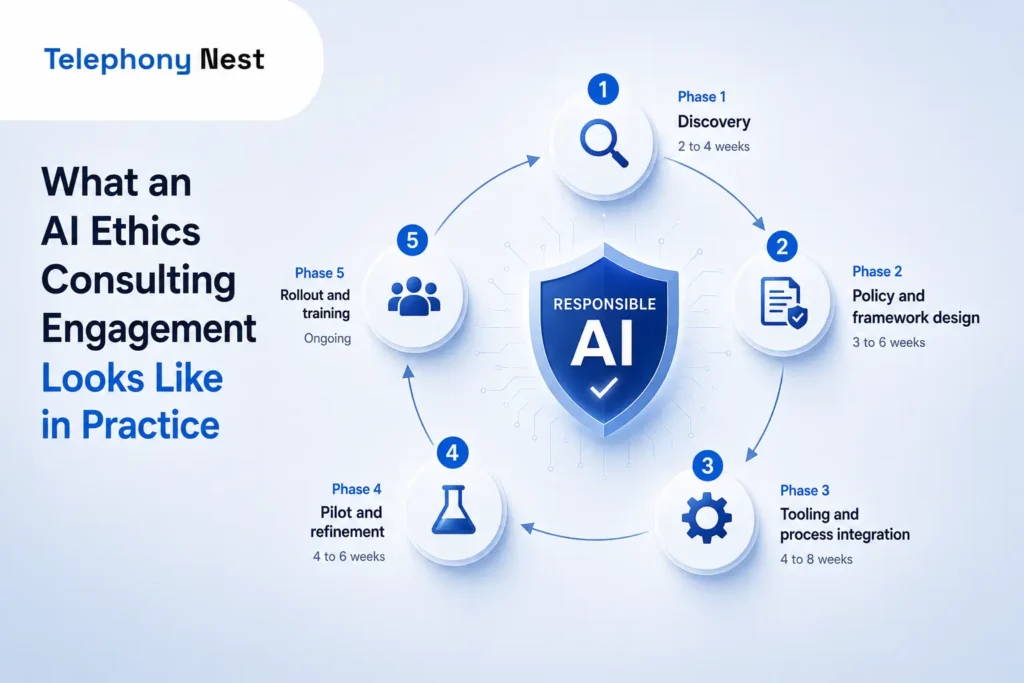
Abstract descriptions help nobody. A typical engagement runs through phases that look like this:
Phase 1: Discovery (2 to 4 weeks)
Inventory existing AI use. Map regulatory exposure. Interview stakeholders. Document current controls. Output is a current-state report and a prioritized risk register.
Phase 2: Policy and framework design (3 to 6 weeks)
Draft the AI policy. Design the governance structure. Build the use case classification methodology. Output is a set of approved policy documents and a governance charter.
Phase 3: Tooling and process integration (4 to 8 weeks)
Stand up the model inventory. Integrate impact assessments into product workflows. Build evaluation harnesses for priority use cases. Output is operational tooling, not slides.
Phase 4: Pilot and refinement (4 to 6 weeks)
Run a high-priority use case through the full process end to end. Find what breaks. Fix it. Output is a working reference implementation.
Phase 5: Rollout and training (ongoing)
Expand to additional use cases. Train teams. Build internal capability so the program runs without the consultant. Output is independence.
Total elapsed time for an initial program is typically three to nine months. Multi-year programs exist, but they are usually expansions of a successful initial engagement, not single contracts.
Pro Tip
If a consulting proposal jumps straight to Phase 2 without Phase 1, ask what assumptions they are making about your environment. The fastest way to waste budget is to design controls for a system you have not actually mapped yet.
The Internal Capabilities You Should Build, Not Outsource
A common failure pattern: a company outsources its entire responsible AI function. Two years later, the consultant leaves, and the program collapses. Some functions belong inside the company permanently.
Keep internal:
- Final accountability for AI risk decisions.
- Ownership of the AI policy and its updates.
- Day-to-day operation of the governance committees.
- Incident response leadership.
- Relationships with regulators and auditors.
Reasonable to outsource:
- Initial framework design and templates.
- Specialized red teaming and adversarial testing.
- External assurance and audit support.
- Training program development.
- Tooling selection and implementation.
The pattern is consistent: a consulting partner accelerates the build, but ownership stays inside. A partner who structures the engagement to make themselves indispensable is structuring it wrong.
How to Evaluate an AI Ethics Consulting Partner
A short checklist that filters most of the noise:
- Ask for a sample model card, governance charter, or risk assessment they have produced. Redacted is fine. No artifact means no track record.
- Ask how they handle a model that fails an evaluation. A good answer references specific decisions, not a policy summary.
- Ask which regulations they have helped clients prepare for. Specifics about the EU AI Act, NIST AI RMF, ISO/IEC 42001, or sector rules signal real exposure.
- Ask who on their team has engineering experience. If the team is entirely former policy or compliance staff, the work will not survive a code review.
- Ask what they will not do for you. A partner with no boundaries is a partner who will accept any scope and deliver none of it well.
At TelephonyNest, we treat responsible AI as part of the build, not a layer applied to it. Our engagements integrate governance, evaluation, and monitoring into the same delivery pipeline that produces the model. That sequencing matters more than any framework.
The Bottom Line
Responsible AI is not a movement anymore. It is a control function. It belongs in the same conversation as security, privacy, and financial controls, with the same expectations of evidence, auditability, and incident response.
Companies that treat AI ethics consulting as a PR investment will continue to produce values statements and lose deals. Companies that treat it as risk infrastructure will keep deploying models when others have to pause.
The shift has already happened. The companies still debating whether responsible AI is a real category are the ones who will spend 2026 explaining a public failure to a regulator or a board.
If you are building or scaling AI in production, the question is no longer whether to invest in responsible AI consulting. It is whether to do it before or after your first serious incident.