Blog Summary
Agentic AI has reached the boardroom, but most enterprises have a strategy without a working integration plan. This article explains what agentic AI integration consulting actually involves, why enterprises are moving fast in 2026, and how the work differs from generic AI advisory. It covers where projects break, the playbook that survives production, and the diligence signals that separate real partners from demo vendors.
Agentic AI has reached the boardroom. Most enterprises have an agent strategy now. Far fewer have a working integration plan behind it.
That gap is the entire story of 2026. Gartner projects that 40% of enterprise applications will embed task-specific AI agents by the end of 2026, up from less than 5% the year before. The pace is real. The risk is also real.
In its April 2026 Hype Cycle for Agentic AI, Gartner made the point bluntly. Integration and deployment are where agentic value is realized. Agents rarely operate in isolation. That single observation is the entire reason agentic AI integration consulting now exists as a category.
This article explains what that consulting actually involves, why enterprises are moving fast, and how the work differs from generic AI advisory.
What Agentic AI Integration Consulting Actually Is
Agentic AI integration consulting is the work of connecting autonomous agents to the systems an enterprise already runs. CRMs, ERPs, ticketing platforms, communication stacks, data warehouses, identity systems.
Building an agent is not the hard part anymore. Frameworks and platforms have made that comparatively easy. The hard part is making the agent reliable inside a real enterprise environment with 50 to 200 connected systems.
The consulting work covers four things in practice.
- Architectural design across agents, tools, data, and orchestration layers.
- Integration with existing systems through APIs, MCP servers, and event streams.
- Governance, observability, and human-in-the-loop controls.
- Post-launch monitoring, evaluation, and continuous improvement.
Each layer fails for different reasons. Each needs different expertise. A single missing piece can stall an entire program.
Why Enterprises Are Moving Fast
Agentic AI is no longer a research conversation. The pressure to move is now coming from the business side, not the technology side.
Agentic AI in 2026 by the Numbers
Enterprise applications expected to embed task-specific AI agents by end of 2026
Enterprise apps shipped or updated in Q1 2026 that already embed an agent
Enterprises currently running AI agents in production, despite high adoption
Agentic AI projects Gartner expects to be canceled by end of 2027
1. Competitive Pressure Has Crossed a Threshold
Industry data through Q1 2026 shows roughly 80% of enterprise applications shipped or updated in that quarter embed at least one AI agent. That figure was around a third in 2024. Agents are now the default, not the exception.
Companies that delay risk falling behind on customer experience, internal efficiency, and operating costs at the same time.
2. The Production Gap Is Now a Public Problem
Adoption is high. Production is not. Roughly four in five enterprises have adopted AI agents in some form. Only about one in nine runs them in production. That gap is the largest deployment backlog in recent enterprise technology history.
Boards are now asking specifically about the path from pilot to production. Consulting engagements are framed around closing that gap.
3. Failure Rates Are Sobering Buyers
Gartner has warned that over 40% of agentic AI projects will be canceled by the end of 2027. The reasons are predictable. Escalating costs, unclear business value, inadequate risk controls.
Enterprises now want a partner who can prevent that outcome, not just deliver a demo.
4. Integration Complexity Has Become the Bottleneck
Surveys put integration at the top of the challenge list. Roughly six in ten organizations cite integration complexity as their biggest barrier to scaling agents. A typical enterprise has between 50 and 200 systems an agent might need to touch. Most of those systems were never designed for autonomous access.
Integration is no longer a technical detail. It is the program.
How Agentic AI Integration Differs From Traditional AI Consulting
Traditional AI consulting was largely about model selection and analytics. Agentic AI integration is about action. An agent does not just predict. It acts on systems. That changes everything about the engagement.
From Prediction to Action
A model that predicts churn carries low operational risk. An agent that drafts emails, books meetings, updates CRM records, and refunds orders carries high operational risk. Every action it takes touches a real system and creates a real consequence.
Consulting work shifts from accuracy tuning to action governance. What can the agent do, when, with which approvals, and how is it logged.
From Standalone Models to Orchestrated Systems
A single agent is rarely the answer. Most enterprise use cases require multiple agents that coordinate. A sales workflow might involve a research agent, an outreach agent, a scheduling agent, and a CRM agent.
Without orchestration, these become a sprawl. With orchestration, they become a workflow. The architecture decisions that separate those two outcomes are the central deliverable of an integration engagement.
From Data Pipelines to Tool Use
Traditional AI work was dominated by data pipelines. Agentic work is dominated by tool use. Each tool is an API, a database, a queue, or a connected system. Each call has cost, latency, and failure modes that matter.
This is also why the Model Context Protocol has moved so quickly. MCP has become the de facto connectivity standard for the agentic layer, with a fast-expanding ecosystem of servers covering everything from CRMs to internal data stores. For integration teams, it removes a class of custom glue code that used to consume entire engagements.
Where Agentic AI Projects Actually Break
Most failed agentic AI projects do not break in the model. They break in the seams between systems, teams, and policies.
Where Agentic Projects Actually Break
Most failed agentic AI projects do not break in the model. They break in the seams.
- Fragmented data infrastructure that prevents unified agent access across systems.
- Identity and authorization stacks built for humans, not autonomous agents.
- Agent sprawl where every team builds one and nobody centrally owns the architecture.
- Weak observability that makes debugging impossible and compliance undocumentable.
- Governance written as policy instead of enforced in the architecture itself.
Fragmented Data Infrastructure
Agents need unified access across siloed systems. Most enterprises do not have that. Roughly half of organizations cite data infrastructure inadequacy as a barrier to scaling agentic AI. Fragmented data makes agents unreliable in production, even when they perform well in pilots.
Identity and Authorization Gaps
Most enterprise IAM stacks were built for humans and service accounts. Agents need something in between. They act on behalf of users but at machine speed. Without explicit identity design, audit trails break and least-privilege rules collapse.
Agent Sprawl
Marketing builds an agent. Finance builds one. IT builds three. Within a year, an enterprise can have dozens of agents that nobody centrally owns. Each is useful alone. Together they create overlap, conflict, and risk.
Integration consulting includes the governance to prevent sprawl. Not as a policy document, but as an enforced architecture.
Weak Observability
Agents are opaque by default. They reason, choose tools, and act through chains nobody sees. Without proper telemetry, debugging is impossible and compliance is undocumentable.
Observability has become a first-class workstream in serious engagements. Trace logs, tool-call audits, decision provenance, and evaluation pipelines are not optional.
Compliance and Risk Misalignment
Agents acting autonomously raise legitimate compliance questions. Many of these are familiar to teams already thinking about how responsible AI translates into actual business risk. The new dimension with agents is that the AI is not just recommending, it is acting. The liability surface widens accordingly.
What Good Agentic AI Integration Consulting Looks Like
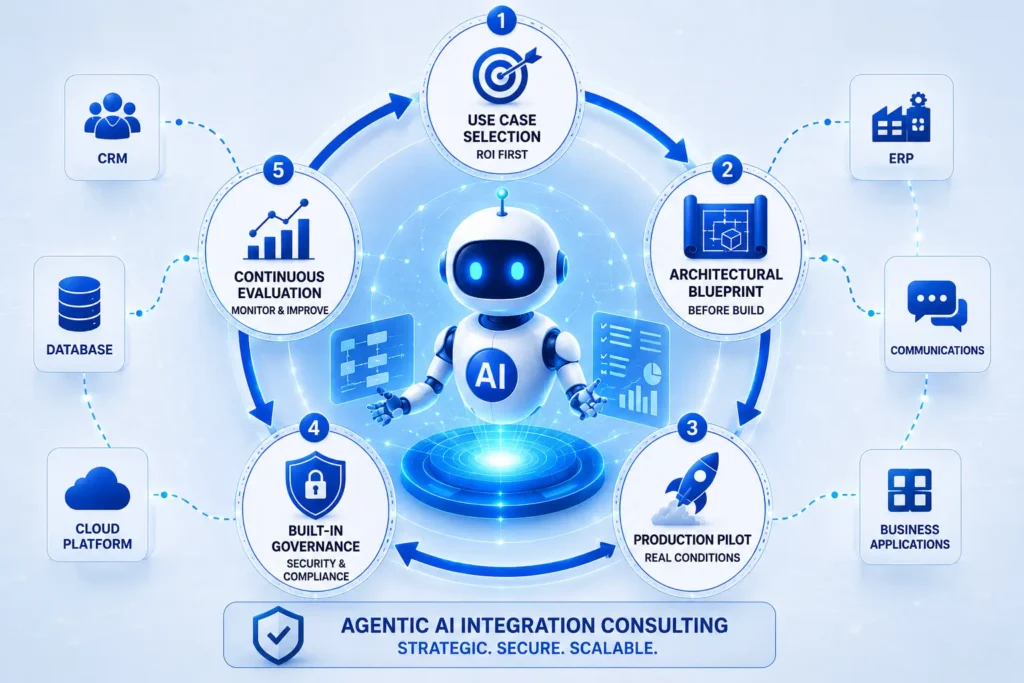
The pattern that works is consistent across engagements. It is not about brilliance. It is about sequence.
Step 1: Use Case Selection With Honest ROI
Most failed projects started with the wrong use case. The bar should be specific. The workflow must be high-volume, rule-rich, integration-heavy, and tied to a measurable business metric.
Good consulting refuses use cases that do not clear that bar. Saying no early is part of the value.
Step 2: Architectural Blueprint Before Build
The blueprint covers agents, tools, data sources, orchestration, identity, observability, and governance. It identifies every system the agent will touch and every action it can take.
Without this blueprint, integration becomes a series of patches. With it, integration becomes a system.
Step 3: Pilot With Real Production Conditions
Pilots that run in sandbox environments are misleading. Real systems behave differently. Real users prompt differently. Real data has edge cases no synthetic data covers.
Good pilots run against production-grade data, with production-grade access, under production-grade observability.
Step 4: Governance Built Into Architecture
Governance written as a policy is not governance. Governance enforced in the architecture is. Role-based access, action approvals, rate limits, escalation paths, and audit logging all live in the code, not just the doc.
Step 5: Continuous Evaluation
Agents drift. Tools change. APIs evolve. Models update. Without continuous evaluation, a working agent silently becomes a broken one.
Evaluation pipelines compare current behavior against established baselines. Drift triggers review. Reviews trigger updates. This loop is the difference between an agent that survives and one that gets canceled in the second year.
Where Agentic AI Integration Lands First in Enterprises
The fastest adoption is happening where workflows are repetitive, integration-heavy, and revenue-adjacent.
Customer Operations
Support, billing, and account management are the most mature category. Agents triage tickets, draft responses, update records, and escalate to humans. The integration surface is wide but well understood.
Sales and Revenue Operations
Lead research, outbound personalization, CRM hygiene, meeting scheduling, and pipeline updates. The agent value is highest when these are connected, not standalone.
IT and Engineering Operations
Incident triage, ticket routing, log analysis, and infrastructure remediation. Engineering use cases benefit from agents because the tools are already API-native.
Finance and Procurement
Invoice processing, vendor onboarding, expense classification, and reconciliation. Heavily regulated, but the workflows are structured enough for agents to add real value.
Healthcare and Other Regulated Sectors
Regulated industries move slower, but not by much. Healthcare, finance, and telecom are now building agents with full compliance frameworks around them. Anyone working in those spaces should approach integration with the same regulatory rigor that applies to AI consulting in healthcare and other compliance-heavy industries, where every action an agent takes has audit and liability implications.
Choosing the Right Agentic AI Integration Partner
The market is loud right now. Many vendors claim agentic AI integration capability. Few have shipped at enterprise scale. The difference shows up fast.
A few diligence signals are worth weighting heavily.
- Production references where agents handle real workflows, not demo scripts.
- Architectural literacy across agents, tools, data, identity, and orchestration.
- A clear point of view on observability and evaluation, not just deployment.
- Governance frameworks built into the architecture, not bolted on later.
- A track record across regulated and unregulated environments.
These signals separate vendors who have shipped at scale from vendors who have read about it. The questions that surface them are the same questions any serious AI consulting engagement should pass through.
The Strategic Stakes for 2026
Agentic AI is becoming infrastructure. Like cloud before it, the early architecture choices will compound for years. Enterprises that move fast and move well will set the operating model for their next decade. Enterprises that delay will be integrating against an industry that already moved on.
The right partner does three things. Maps the workflows that actually justify agents. Builds the integration architecture that survives production. Establishes the governance that keeps it auditable.
If you are building a real agentic AI roadmap, or trying to recover one that has stalled in pilot, our team works on exactly this kind of integration. We can walk through your current architecture, candidate use cases, and integration surface in a focused working session.
The Bottom Line
Agentic AI is moving from interesting to inevitable. The enterprises that win this cycle will not be the ones with the most agents. They will be the ones whose agents actually work inside their systems.
That is what agentic AI integration consulting delivers. Everything else is a demo.