
Blog Summary
Healthcare is adopting AI faster than its rulebook can keep up, and the gap is where most projects quietly fail. This article explains how regulated organizations navigate AI without breaking compliance. It covers the full regulatory stack, where pilots actually break, and the playbook consulting partners use to keep innovation auditable.
Healthcare is racing into AI faster than its rulebook can keep up. Adoption has crossed the tipping point. Compliance frameworks have not. That gap is where most healthcare AI projects quietly fail.
By early 2026, nearly half of all U.S. healthcare organizations are actively implementing generative AI across clinical and operational workflows. Physician adoption jumped from 38% to 66% in a single year. The technology is writing clinical notes today. It is triaging patients through chatbots. It is reading scans and flagging risk.
Yet most of these tools were deployed without a clear governance framework. They sit on PHI. They influence clinical decisions. They expose the organization to HIPAA, state AI laws, and FDA scrutiny all at once.
This article explains how regulated healthcare organizations actually navigate AI adoption. It covers the regulatory stack, where projects break, and what role consulting plays in keeping innovation compliant.
The Compliance Gap Healthcare Leaders Are Quietly Facing
Healthcare AI in 2026 by the Numbers
U.S. physicians now using AI tools, up from 38% the prior year
U.S. healthcare organizations actively implementing generative AI
2025 HIPAA enforcement cases citing risk analysis failures
ROI advantage for consolidated AI platforms over fragmented deployments
Most healthcare AI projects do not fail because the model is wrong. They fail because nobody mapped the regulatory surface before deployment.
HIPAA is the floor, not the ceiling. The HHS Office for Civil Rights resolved 21 HIPAA enforcement cases in 2025. 76% included penalties for risk analysis failures. The proposed HIPAA Security Rule update, expected in 2026, removes the addressable safeguard distinction. It also mandates annual risk assessments that explicitly cover AI systems.
State laws add another layer. Texas, Colorado, and California now have AI-specific rules that apply to healthcare. Some require disclosure when AI influences a clinical decision. Some demand bias audits. Some mandate human review of automated outputs.
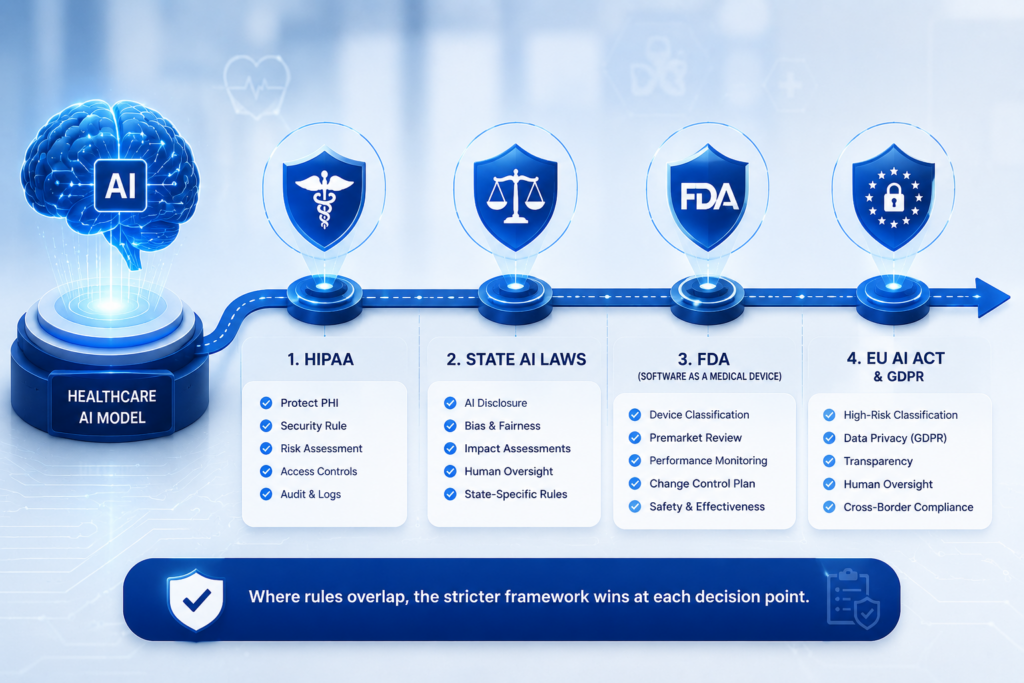
Then comes the FDA. Software as a Medical Device rules apply to many AI tools, especially in diagnostics. The EU AI Act extends the surface for any provider with cross-border patients.
Most healthcare AI deployments touch three or four of these frameworks at once. Few are mapped to any of them on day one.
What Gets Missed in Most AI Healthcare Pilots
Compliance Watchout
Where healthcare AI projects quietly fail:
- BAAs that do not cover model training, inference, or output storage.
- Clinical teams deploying AI tools without IT or compliance involvement.
- No documented risk analysis covering the specific AI system in use.
- Vendor models that train on customer data without contractual limits.
- No incident response plan for AI hallucinations affecting patient care.
Compliance gaps rarely show up in the pilot. They show up six months later, during an audit, an incident, or a vendor review.
Common gaps we see across healthcare AI engagements:
- Business Associate Agreements that do not cover model training, inference, or output storage.
- AI tools deployed by clinical teams without IT or compliance involvement.
- No documented risk analysis covering the specific AI system in use.
- Vendor models that train on customer data without explicit contractual limits.
- No audit trail for AI-influenced clinical decisions.
- No incident response plan for AI hallucinations affecting patient care.
Shadow AI is a major part of this. One mid-sized health system found that 23% of clinicians were regularly using ChatGPT for documentation tasks. None of it was governed. All of it was exposing PHI.
The Regulatory Stack Healthcare AI Must Clear
Before any model goes near patient data, the regulatory map has to be clear. Skipping this step is the single most expensive mistake in healthcare AI.
HIPAA and the New Security Rule
HIPAA governs protected health information at every stage of the pipeline. That includes training data, inference inputs, model outputs, and logs. The full technical safeguards apply across the entire AI lifecycle.
The 2026 Security Rule update raises the bar. Annual risk assessments must now explicitly cover AI systems. Encryption is no longer optional. Multi-factor authentication is required. Vulnerability scanning must be continuous.
State AI Laws
State-level rules now create real obligations for healthcare AI. Colorado requires algorithmic impact assessments. Texas mandates disclosure for consequential decisions. California layers automated decision-making rules onto existing CCPA protections.
Health systems operating across multiple states face overlapping rules. The compliance burden multiplies fast.
FDA and Software as a Medical Device
Any AI tool that diagnoses, treats, or substantially influences clinical decisions may qualify as a medical device. FDA classification determines whether premarket review applies.
Predetermined Change Control Plans now allow some AI updates without resubmission. But the original classification still matters. Most consulting work begins by mapping each AI use case to FDA risk tiers.
EU AI Act and GDPR Crossover
Any U.S. provider with international patients, clinical trial participants, or EU employee data falls under GDPR. The EU AI Act adds high-risk classifications for many healthcare uses.
Where rules overlap, the stricter framework wins at each decision point. That principle drives most cross-border architecture choices.
Where AI Consulting Earns Its Keep in Healthcare
AI consulting in healthcare is not a generic technology engagement. The work spans regulatory mapping, clinical workflow design, data governance, vendor evaluation, and post-launch monitoring.
If you want a broader view of what AI consulting covers across industries, our guide on what AI consulting actually involves is a useful starting point. Healthcare adds regulatory depth on top of every step.
1. Use Case Triage and Risk Classification
Not every AI use case carries the same risk. A scheduling bot is not a diagnostic model. A documentation assistant is not a triage system.
Good consulting begins by sorting use cases by clinical risk, PHI exposure, and regulatory classification. High-risk uses get heavier governance. Low-risk uses move faster.
2. Regulatory Mapping for Each Use Case
Each shortlisted use case gets mapped to its full regulatory surface. HIPAA, state laws, FDA classification, EU exposure, and any specialty rules like 42 CFR Part 2 for substance use records.
The deliverable is a compliance map that names every obligation, every safeguard, and every documentation requirement.
3. Vendor Evaluation Beyond Certifications
SOC 2 and HIPAA certifications are baseline, not differentiators. Real compliance risk lives in AI architecture, not certifications. The questions that matter are different.
Does the vendor train on customer data? How are model outputs logged? Who controls the audit trail? Is there a retrieval layer with validation, or does the model generate freely? These details decide compliance, not the certification badge.
Our deeper guide on how to choose the right AI consulting company covers the diligence questions that apply across regulated industries.
4. Architecture for Compliance
Compliant healthcare AI almost always uses retrieval-based architectures with validation layers. Free-generation models are too unpredictable for clinical settings.
The architecture typically includes encrypted PHI handling, role-based access controls, explainability layers, and human-in-the-loop checkpoints. Each is a regulatory requirement, not a feature.
5. Governance That Actually Works
Governance is where most healthcare AI programs collapse. Organizations with structured governance frameworks reach positive ROI in 7.5 months, versus 13.5 months for those without. That gap compounds across a portfolio.
Good governance means a documented AI inventory, a defined approval workflow, regular bias audits, and ongoing performance monitoring against clinical baselines.
Where Healthcare AI Projects Actually Break
Most healthcare AI failures follow predictable patterns. Each one is avoidable with the right consulting structure.
Hallucinations in Clinical Context
A hallucinated drug interaction can harm a patient. A hallucinated symptom summary can mislead a clinician. In regulated settings, hallucinations are not a quirk. They are a compliance and liability event.
Mitigation requires retrieval grounding, output validation, and clear thresholds for human review.
Bias in Training Data
Healthcare AI trained on historical data can encode historical inequities. Diagnostic models have shown lower accuracy for under-represented populations.
Bias audits are now a regulatory expectation, not a best practice. Several state laws now require them by statute.
If you want a deeper look at this dimension, our guide on AI ethics consulting and why responsible AI is now a business risk covers the audit frameworks that map directly to healthcare use cases.
Explainability Failures
Clinicians will not act on recommendations they cannot trace. Explainability is not a nice-to-have feature. It is the adoption barrier you must solve architecturally.
If a model cannot explain why it flagged a case, it will not survive clinical review. It also will not survive a regulatory audit.
Generative AI Without Guardrails
Generative AI is where most current healthcare projects sit. It is also where most current healthcare risk sits. Our generative AI consulting guide lays out where the hype ends and real implementation begins. In healthcare, that line matters more than anywhere else.
A Practical Playbook for Healthcare AI Adoption
This is the sequence that consistently produces compliant, useful healthcare AI. It is not the only way. It is the way that works without breaking compliance.
Step 1: Build an AI Inventory
Most health systems do not know how many AI tools they actually use. The first step is a structured inventory covering procurement records, network traffic, staff surveys, and vendor disclosures.
Classify each tool by PHI access, clinical risk, and current governance status. You will almost always find more tools than your IT team expected.
Step 2: Run a Compliance Gap Assessment
Map each inventoried tool to its regulatory surface. Identify gaps in BAAs, risk assessments, audit trails, and incident response coverage.
Prioritize remediation by exposure, not by ease.
Step 3: Establish Governance
Create an AI governance committee with clinical, IT, legal, and compliance representation. Define an approval workflow for new AI tools. Set thresholds for clinical risk that require committee review.
Step 4: Pilot With Clinical Oversight
New AI tools should pilot with clear success metrics, clinical oversight, and baseline performance comparisons. Pilots without metrics are guesses.
Step 5: Monitor Continuously
Healthcare AI models drift. Patient populations change. Clinical guidelines update. Continuous monitoring against performance baselines is now a regulatory expectation, not a preference.
What the ROI Actually Looks Like
Healthcare AI delivers measurable value when governance is in place. Without it, the same investments routinely lose money or generate liability.
McKinsey research documents a 3.5x ROI advantage for organizations using consolidated AI platforms versus fragmented deployments. The multiplier comes from compounding effects. AI scribes save physician time. AI receptionists fill that time. AI documentation tools reduce burnout. Each piece reinforces the next.
Fragmented deployments lose that compounding effect. They also multiply the compliance surface. Consolidation is the cleaner path on both ROI and risk.
Working With a Healthcare AI Consulting Partner
Healthcare AI consulting is judged on three things. Regulatory depth. Clinical understanding. Architectural rigor. Generic AI consulting will not clear the bar.
We work with regulated organizations across healthcare, finance, and telecom. The pattern is consistent. Map the regulatory surface first. Build governance second. Deploy third. Monitor always.
If you want to explore where your AI roadmap sits against current healthcare compliance obligations, get in touch with our team. We can walk through your specific use cases, vendor stack, and regulatory exposure in a working session.
The Bottom Line
Healthcare AI is no longer optional. Compliance failure is no longer recoverable. The organizations that get this right in 2026 will not be the ones with the most AI tools. They will be the ones with the cleanest map between AI capability and regulatory obligation.
That map is what consulting actually delivers. Everything else is implementation.