
Blog Summary
The AI agent market in 2026 has more vendors than capabilities and more demos than working systems. This is a buyer’s guide for technology leaders evaluating AI agent development services. It covers what the work actually includes, what it costs, the architectural choice between productized and custom builds, the five questions that surface agent washing, and the contract clauses serious buyers insist on before they sign.
AI agents are no longer a research demo. They are sitting inside support queues, sales workflows, finance close cycles, and field operations. The market has shifted from “should we try this” to “who builds it for us.”
Gartner expects 33% of enterprise software applications to embed agentic AI by 2028, up from less than 1% in 2024. The same Gartner team also predicts over 40% of agentic AI projects will be cancelled by the end of 2027.
Both numbers are true at the same time. The market is real. The failure rate is also real. The variable in the middle is the partner doing the build.
This is a buyer’s guide. It is written for technology leaders evaluating AI agent development services and trying to separate vendors who ship production systems from vendors selling rebranded chatbots. We will cover what these services actually include, what they cost, how to architect the engagement, and what to put in the contract before you sign anything.
What AI Agent Development Services Actually Cover
The AI Agent Market by the Numbers
Enterprise software applications expected to embed agentic AI by 2028, up from less than 1% in 2024
Agentic AI projects Gartner expects to be canceled by the end of 2027
Vendors delivering genuine agentic capabilities, out of thousands claiming to
Range by which most enterprise budgets underestimate true total cost of ownership
Most vendor websites describe AI agent development as a single service. In practice, a serious engagement spans six different workstreams, and you need a partner who can execute all of them.
Discovery and use case scoping
This is where you decide what the agent will do and, more importantly, what it will not do. Bad scoping is the most common reason agent projects fail. A good partner will push back on use cases that look great in slides but break under real data.
Architecture and model selection
Agents need a reasoning model, a memory layer, a planning layer, and a tool-use layer. The right architecture depends on whether you need a single agent doing one job or a multi-agent system coordinating across workflows. Picking the wrong architecture early is expensive to unwind later.
Data and retrieval engineering
Foundation models score around 60-70% accuracy on domain-specific enterprise tasks out of the box. Closing the gap to production accuracy requires retrieval pipelines, embeddings, vector search, and clean knowledge sources. This work is invisible in demos and unavoidable in production.
Integration with your stack
An agent that cannot read your CRM, write to your ticketing system, or call your internal APIs is a chatbot with extra steps. Real integration covers authentication, rate limiting, error handling, and rollback paths. Most enterprises underestimate integration effort by 30 to 50%.
Observability, evaluation, and guardrails
Agents that run without monitoring become liabilities the day after launch. You need tracing across every reasoning step, cost tracking per token, accuracy benchmarks against a golden test set, and guardrails for safety, PII handling, and prompt injection. This layer is non-negotiable for regulated industries.
Post-launch operations and iteration
Agents are not deployed once. They are tuned continuously based on production feedback, edge case handling, and model drift. Vendors who hand you a finished build and walk away are setting you up to inherit a system you cannot maintain.
The Two Architectural Shapes Every Buyer Must Choose Between
Before you scope a project, you need to decide what you are actually building. There are two patterns that cover most enterprise AI agent work, and they have very different cost structures, timelines, and vendor profiles.
Productized AI agents
These are pre-built agents from vendors like Salesforce Agentforce, Microsoft Copilot Studio, or domain-specific platforms. You configure rather than build. Time to first value is fast, often weeks. Costs are predictable through subscription pricing. The trade-off is that you fit your workflow to the vendor’s model, not the other way around.
Productized agents work well when your use case is common across the industry, your data sits in a supported system, and your differentiator is not the agent itself.
Custom AI agent development
These are agents built specifically for your workflow, your data, and your operational context. Development takes longer, usually three to six months for a meaningful first deployment. Costs are higher upfront but lower in licensing over time. You own the IP, the architecture, and the upgrade path.
Custom development is the right choice when your competitive advantage is operational, when your data cannot leave your environment, when compliance requires audit trails the productized vendor cannot expose, or when no existing product covers your workflow. The pricing logic here mirrors the broader market for AI consulting services, where scope shape, not headcount, drives the number.
The hybrid path
Many production deployments combine both. A productized layer handles common workflows. A custom agent layer handles the workflows that drive competitive advantage or sit on sensitive data. The right partner will tell you when a hybrid is the honest answer, not push you toward whichever side they happen to sell.
What AI Agent Development Actually Costs in 2026
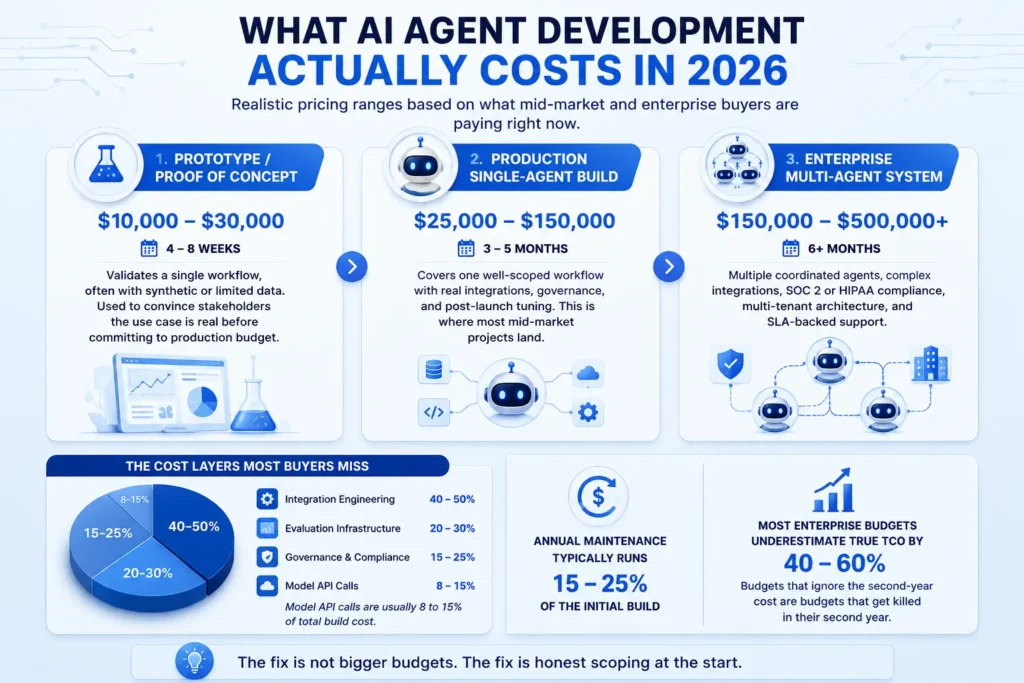
Pricing for AI agent development is wide because the work itself is wide. Anyone giving you a single number without seeing your scope is guessing. Here is the honest range based on what mid-market and enterprise buyers are paying right now.
Prototype or proof of concept
$10,000 to $30,000. Four to eight weeks. Validates a single workflow, often with synthetic or limited data. Used to convince stakeholders the use case is real before committing to production budget.
Production single-agent build
$25,000 to $150,000. Three to five months. Covers one well-scoped workflow with real integrations, governance, and post-launch tuning. This is where most mid-market projects land.
Enterprise multi-agent system
$150,000 to $500,000 and up. Six months and longer. Multiple coordinated agents, complex integrations, SOC 2 or HIPAA compliance, multi-tenant architecture, and SLA-backed support.
The cost layers most buyers miss
Model API calls are usually 8 to 15% of total build cost. The dominant costs sit in integration engineering, evaluation infrastructure, governance setup, and ongoing operations. Annual maintenance typically runs 15 to 25% of the initial build. Budgets that ignore the second-year cost are budgets that get killed in their second year.
Industry data on the gap between projected and actual TCO is consistent: most enterprise budgets underestimate true total cost of ownership by 40 to 60%. The fix is not bigger budgets. The fix is honest scoping at the start, which is one of the sharper signals when choosing the right AI consulting company for a build of this size.
By The Numbers
The Five Questions That Separate Real Vendors from Agent Washing
Five Procurement Watchouts
Signs you are buying a rebranded chatbot, not an AI agent:
- The vendor cannot point to a live production agent of theirs running with real users.
- Evaluation is described as “manual testing” or “the model is just really good.”
- No clear answer on guardrails, rollback procedures, or human-in-the-loop checkpoints.
- The contract gives the vendor ownership of your prompts, tuning artifacts, or evaluation data.
- Handover is a two-week support window instead of paired operation with your team.
Reuters reported that of the thousands of vendors in the agentic AI market, only about 130 deliver genuine agentic capabilities. The rest are rebranding chatbots, RPA tools, and assistants. This is called agent washing, and it is the single biggest procurement risk in this category right now.
These five questions will surface the difference within thirty minutes of conversation.
1. Can you show me an agent of yours running in production right now?
Not a demo. Not a video. A live system with real users, real data, and real failure modes. If they cannot point to one, they are still in the pilot phase themselves. That is fine for a research engagement. It is not fine if you are buying production.
2. How do you evaluate your agents before and after deployment?
Good answers include golden test sets, regression suites, accuracy benchmarks against human baselines, and continuous evaluation in production. Bad answers include “we test it manually” or “the model is just really good.” Evaluation is engineering, not vibes.
3. What happens when the model gets it wrong?
Every production agent fails. The question is how. A serious vendor will describe their guardrails, their human-in-the-loop checkpoints, their rollback procedures, and the failure modes they have already seen and fixed. A vendor who says their agent does not fail has not deployed it.
4. Who owns the IP, the prompts, the fine-tuning, and the evaluation data?
This is a contract question, not a technical one, but it tells you whether the vendor sees you as a long-term partner or as someone they can lock in. Default to owning everything you paid to create. Walk away from vendors who insist on owning your prompts or your tuning artifacts.
5. What does your handover and knowledge transfer look like?
Six months after launch, can your team operate, monitor, and extend the agent without the vendor? If the answer is no, you are not buying an agent. You are buying a dependency.
How the Development Process Actually Works
Real AI agent engagements follow a phased structure. Vendors who skip phases or compress them into one sprint are either inexperienced or selling you a demo dressed as a product.
Phase 1: Discovery and feasibility
Two to four weeks. The team maps your workflow, reviews your data, identifies integration points, and pressure-tests the use case. The output is a written feasibility document with a clear go/no-go recommendation. If the partner skips this phase, you are paying for their learning curve later.
Phase 2: Architecture and prototype
Four to eight weeks. The team builds a working agent against a controlled slice of your data. The goal is to prove the core reasoning loop, the integration pattern, and the accuracy baseline. This is where you decide whether to scale or stop.
Phase 3: Production build
Two to four months. Full integration with production systems, evaluation infrastructure, observability, guardrails, and security review. This phase is where most of the budget goes and where most of the risk lives.
Phase 4: Controlled rollout
Four to six weeks. The agent goes live to a small user group with heavy monitoring. The team tunes prompts, fixes edge cases, and validates the production accuracy matches the prototype. Skipping controlled rollout is how agents go viral in support tickets, not in a good way.
Phase 5: Scale and managed operations
Ongoing. Continuous evaluation, prompt tuning, model upgrades, and expansion to adjacent workflows. The best agents improve through use. The worst degrade through neglect.
What to Put in the Contract Before You Sign
The technical scope is only half the deal. The other half is what happens when something goes sideways. These are the contract clauses serious buyers insist on.
Acceptance criteria tied to measurable accuracy
Define what “working” means before the build starts. Accuracy thresholds, latency targets, and cost-per-task budgets, all written down. Without this, you have no leverage when the vendor declares the project complete and you disagree.
IP and data ownership
You own your data, your prompts, your fine-tuning artifacts, and any models trained on your data. The vendor can keep their generic frameworks and tooling. Get this in writing before discovery starts.
Exit and handover provisions
If the engagement ends, the vendor delivers documented code, infrastructure-as-code definitions, runbooks, and a defined handover period. Two weeks of “send us your questions” is not handover. Two months of paired operation with your team is.
Liability for agent failures
Agents that send the wrong email, approve the wrong refund, or update the wrong record create real-world damage. Negotiate clear liability terms. Most vendors will resist. Push anyway.
Cost ceilings on model inference
LLM costs can spike during incidents, prompt injection attempts, or runaway loops. Get a vendor-side commitment to cost controls, alerting thresholds, and circuit breakers. Otherwise you will discover the bill the same week you discover the bug.
Where AI Agent Services Fit in a Broader AI Program
AI agents are not a standalone investment. They sit inside a wider AI roadmap that usually includes data infrastructure, model governance, retrieval systems, and integration platforms. Buying agents in isolation, without thinking about the layers underneath, is how you end up with seven pilots and zero production deployments.
Teams still mapping where agents fit in their roadmap usually need to step back and answer what AI consulting looks like at their stage of maturity first. For organisations already past that question and into the orchestration layer, agentic AI integration consulting covers the platform and multi-agent decisions in more depth.
The right sequence is usually: a data and integration audit first, then a single high-value agent in production, then expansion. Vendors who push you toward enterprise multi-agent platforms before you have shipped a single agent are selling you complexity you have not earned yet.
How TelephonyNest Approaches AI Agent Development
We operate as a sub-brand of Ecosmob Technologies, which has shipped enterprise software for 18 years. That background shapes how we build agents. We treat them as production systems first and AI experiments second.
In practice that means we will not start a build before discovery is done, we will not bypass evaluation infrastructure to hit a demo deadline, and we will tell you when productized agents are the better answer for your scope. We are not interested in selling you a multi-agent platform when one well-tuned single agent will do the job.
Our engagements typically include written acceptance criteria, full IP transfer, documented handover, and post-launch tuning windows built into the contract. The work we do not put in writing, we do not do.
The Honest Bottom Line
The AI agent market in 2026 has more vendors than capabilities, more pilots than production deployments, and more demos than working systems. The 40% project cancellation rate is not random. It tracks closely with how much discipline went into the scoping, the contract, and the partner choice.
Serious buyers ask harder questions, write tighter contracts, and pick partners who can show them production systems before they show them a deck. That is the entire difference between joining the 60% that scale and the 40% that get cancelled.
If you are scoping an AI agent build right now and want a sanity check on architecture, vendor shortlist, or contract structure before you sign, that is the kind of conversation we have every week. The technology is real. The risk is real. The difference is in the choices you make before the work starts.