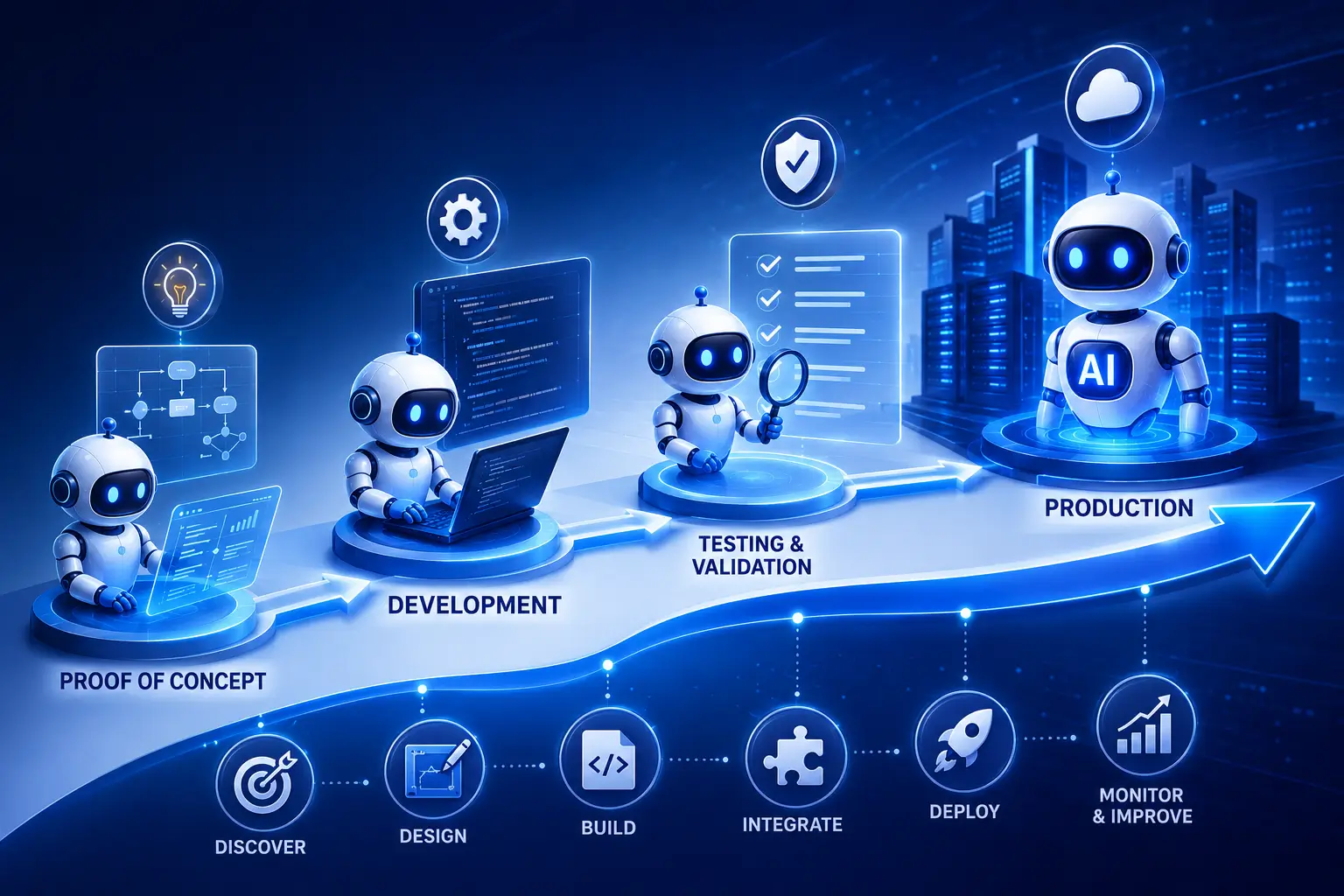
Blog Summary
Custom AI agent development succeeds or fails between the demo and deployment. This walkthrough breaks the journey into five phases with realistic timelines. It covers use case validation, proof-of-concept builds, supervised pilots, production hardening, and monitoring. It also flags the failure points that cancel many agent projects.
Every AI agent demo looks impressive. The agent answers questions, calls tools, and completes tasks on cue. Then the demo ends, and the hard work begins.
Moving a custom agent from proof-of-concept to production is where teams struggle. The gap is rarely about model quality. It comes from missing engineering discipline, evaluation rigor, and operational readiness. We have watched that gap stall promising projects across industries.
This article walks through the full journey, phase by phase. It covers validation, prototyping, piloting, hardening, and deployment. It also shows where budgets and timelines actually land.
Why Most Agent Projects Die Between Demo and Deployment
The numbers behind agent projects are sobering. Gartner predicts over 40% of agentic AI projects will be canceled by the end of 2027. Escalating costs, unclear business value, and weak risk controls drive those cancellations.
Generative AI pilots show the same pattern. MIT research covered by Fortune found 95% of enterprise GenAI pilots stall. Only about 5% achieve rapid, measurable revenue acceleration.
The reasons repeat across companies. Teams build demos that work under controlled conditions. Production conditions are never controlled. Real users phrase requests in unexpected ways. Real systems return malformed data and timeout errors. Real stakeholders demand audit trails and rollback plans. A proof-of-concept ignores all of this by design. Production cannot.
Yet the direction of travel is unmistakable. Gartner expects agentic AI inside 33% of enterprise software by 2028. That figure sat below 1% in 2024. The winners will be teams that respect the production gap.
By The Numbers: The Agent Production Gap
Agentic AI projects Gartner expects to be canceled by end of 2027
Enterprise GenAI pilots that stall without measurable P&L impact (MIT)
Enterprise software applications expected to include agentic AI by 2028
The same figure in 2024, showing how fast adoption is moving
The Five Phases of Custom AI Agent Development
Successful builds follow a predictable arc. The phases below reflect how we structure agent engagements. Timelines assume one focused use case and an available data owner.
Phase 1: Discovery and Use Case Validation (Weeks 1–3)
Strong projects start with one narrow, measurable workflow. This is standard AI consulting discipline, and agent projects need it most. Pick a process with clear inputs, outputs, and success criteria. Quantify the current baseline before anyone writes code.
Define what the agent must never do. Scope boundaries early, because agents drift toward ambiguity. Map every system the agent must touch. Confirm data access and permissions in writing.
Deliverables: a validated use case, success metrics, and a data access map.
Phase 2: The Proof-of-Concept (Weeks 3–6)
The PoC answers exactly one question. Can a model complete this task reliably enough to continue? Keep the build deliberately small. Use one model, one or two tools, and a basic pipeline.
Test against 50 to 100 real historical examples. Hand-label the outputs and measure accuracy honestly. Most lessons from generative AI consulting engagements apply directly here. Prompt design, retrieval quality, and evaluation sets decide PoC outcomes.
Resist feature requests at this stage. A PoC that does five things proves nothing about any of them.
Deliverables: a scored evaluation set and a clear go or no-go decision.
Phase 3: The Supervised Pilot (Weeks 6–12)
The pilot exposes the agent to real users under supervision. Run it alongside the existing process, never instead of it. Human reviewers approve or correct every agent action. This produces two assets at once. You get risk control, and you get labeled correction data.
Integration is usually the hardest pilot work. The agent must read and write across CRMs, ticketing systems, and databases. This is the exact problem agentic AI integration consulting exists to solve. Expect authentication, permissions, and legacy API quirks to consume real time.
Deliverables: weekly intervention rates, integration coverage, and a pilot exit report.
Phase 4: Production Hardening (Weeks 12–18)
Hardening turns a working agent into a trustworthy system. Five workstreams run in parallel here:
- Guardrails: input filtering, output validation, action allowlists, and spending limits.
- Observability: full traces of every reasoning step and tool call.
- Evaluation: automated test suites that run before every change ships.
- Security: least-privilege access, secrets management, and prompt injection defenses.
- Governance: documented escalation paths and human override controls.
Responsible AI is operational risk management now, not branding. The frameworks behind AI ethics consulting map directly onto agent guardrails. Regulated sectors carry extra weight in this phase. The compliance patterns from AI consulting for healthcare apply to any deployment handling sensitive data.
Deliverables: a hardened system, a test harness, and a governance runbook.
Phase 5: Deployment and Continuous Evaluation (Week 18 Onward)
Launch gradually. Route 10% of traffic first, then expand on metrics. Keep the human fallback path alive for months. Monitor accuracy, latency, cost per task, and escalation rates.
Agent behavior shifts when model providers ship updates. Pin model versions and re-run evaluations before every upgrade. Budget for ongoing tuning from day one. An agent is a product, not a project.
A Real-World Walkthrough: A Support Triage Agent
The scenario below is an illustrative composite of common enterprise patterns. It is not a named client engagement.
A mid-market SaaS company handles roughly 4,000 support tickets monthly. Agents spend hours classifying, routing, and drafting first responses. Leadership wants an agent to triage and draft, not to send.
- Weeks 1–2: Discovery confirms ticket triage as the single use case. Baseline: 14 minutes of human effort per ticket.
- Weeks 3–5: The PoC scores 82% routing accuracy on 100 historical tickets. The team approves a pilot with human review.
- Weeks 6–11: Supervised pilot runs on live tickets. Reviewer intervention falls from 30% to 9% by week eleven.
- Weeks 12–16: Hardening adds guardrails, traces, automated evaluations, and an escalation policy.
- Week 17: Gradual launch starts at 10% of inbound traffic.
- Month 6: The agent fully drafts 41% of tickets. Average handling effort drops to 6 minutes per ticket.
Notice what made this work. One workflow, honest evaluation, supervised exposure, and slow rollout. No phase was skipped to hit a demo date.
Where Agent Projects Break: Five Failure Points
five repeatedly” and before the numbered failure list.Watch Out: A Demo Is Not Readiness
A working demo proves feasibility, not production readiness. Most canceled agent projects skipped evaluation harnesses, cost modeling, or integration testing. If your agent has no automated test suite, it is not production-ready. Treat every untested change as a regression waiting to happen.
Most cancellations trace back to a small set of avoidable mistakes. We see the same five repeatedly.
- No evaluation harness. Teams ship changes on vibes and discover regressions from angry users.
- Unbounded scope. The agent grows new responsibilities before mastering its first one.
- Integration debt discovered late. Legacy APIs and permission models surface in week ten, not week two.
- No cost model. Token spend scales with traffic, and nobody forecasted it.
- Missing ownership after launch. The build team disbands, and the agent quietly degrades.
What It Costs and How Long It Takes
Most custom agent builds run four to eight months end to end. Proof-of-concept budgets typically land between $15,000 and $50,000. Full production builds commonly range from $75,000 to $300,000. Complexity, integration count, and compliance requirements drive the spread.
These bands mirror broader AI consulting services pricing structures. Ongoing costs matter as much as the build. Plan for inference spend, monitoring tooling, and a small maintenance team.
Choosing the Right Development Partner
Vendor claims outpace vendor capability in this market. Gartner estimates only about 130 of thousands of agentic vendors offer genuine agent capability. The rest rebrand chatbots and RPA tools as agents.
Ask for evaluation methodology before asking for demos. Demand references from production deployments, not pilots. The criteria for choosing the right AI consulting company carry over directly. Scope reviews of AI agent development services should cover guardrails, observability, and handover plans.
Final Thoughts
The agent opportunity is real, and so is the production gap. Five disciplined phases close that gap reliably. Validate narrowly, prove honestly, pilot under supervision, harden thoroughly, and launch gradually.
If you are weighing a build, we can help you scope it. Talk to our team about your use case, systems, and constraints.
Frequently Asked Questions
How long does it take to build a custom AI agent?
A focused agent typically takes four to eight months to reach production. A proof-of-concept alone takes three to six weeks.
Why do so many AI agent projects fail?
Most fail from skipped fundamentals, not weak models. Missing evaluation harnesses, late integration work, and unbounded scope cancel projects.
Should we build the agent in-house or hire a partner?
Teams with strong ML engineering and spare capacity can build in-house. Most mid-market teams move faster with an experienced partner. Hybrid models with internal handover work well too.
What does production-ready actually mean for an agent?
It means guardrails, full observability, automated evaluations, and documented human override paths. A demo without these is a prototype.